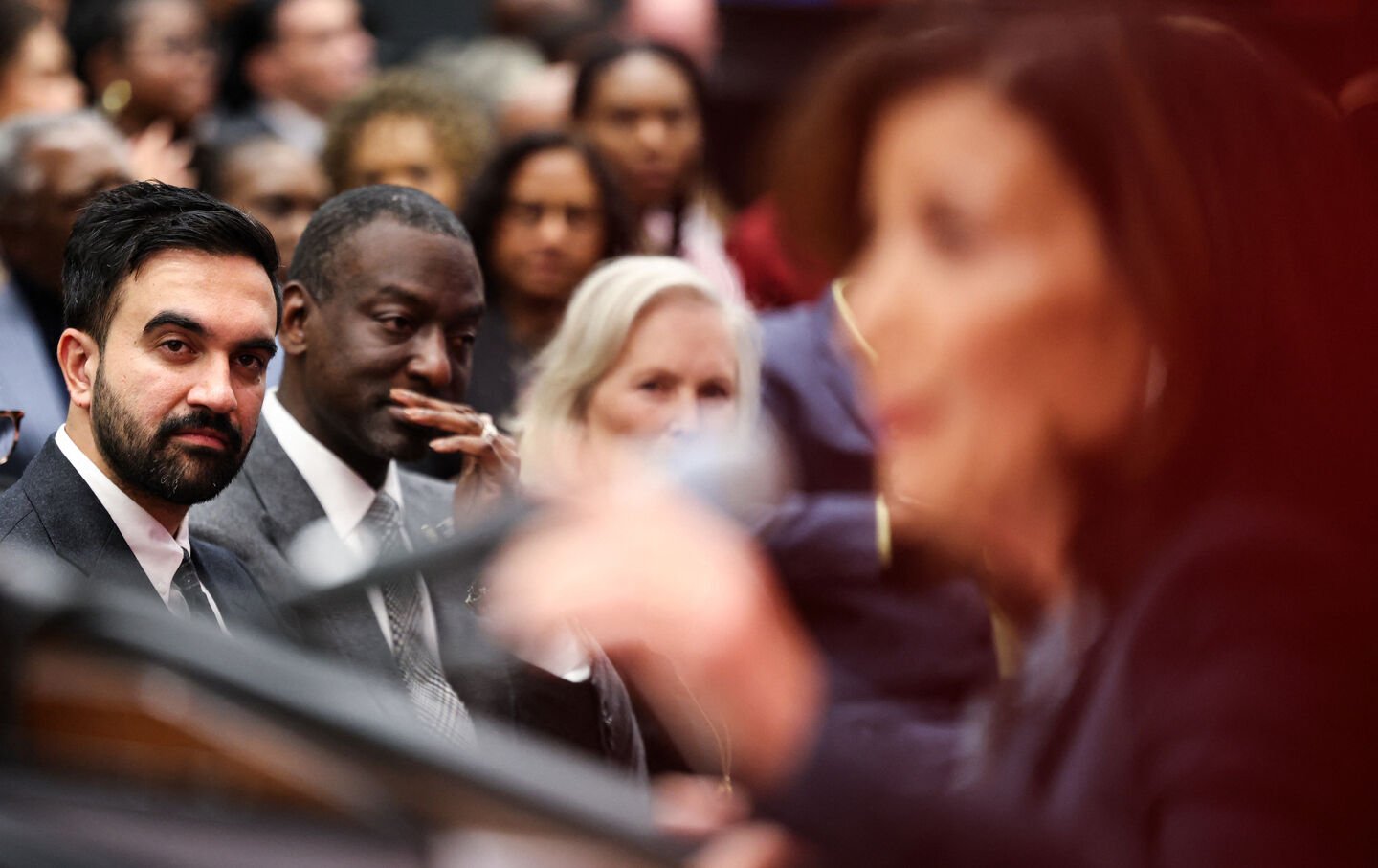
Jon Wiener: From The Nation magazine, this is Start Making Sense. I’m Jon Wiener. Later in the show: Sports Talk on The Nation podcast! Of course Thanksgiving was a big weekend for football on TV – a weekend where millions of viewers got to see a festival of brain injuries — concussions after receiving blows to the head. Dave Zirin will comment; he’s the long-time sports editor of The Nation and host of the Edge of Sports podcast.
But first: Zorhan Mam-DA-ni takes office in four weeks as the first socialist mayor of New York City. How should we understand the constraints he faces without accepting those constraints? Bhaskar Sunkara will comment – in a minute.
[BREAK]
With a socialist taking office as mayor of New York City, what exactly should we be doing? How should we relate to Mamdani and his administration? For some answers, we turn to Bhaskar Sunkara. He’s president of The Nation magazine, founding editor of Jacobin, a columnist for The Guardian, and author of The Socialist Manifesto: The Case for Radical Politics in an Era of Extreme Inequality. Bhaskar, welcome back.
Bhaskar Sunkara: Thanks for having me.
JW: Let’s start with where we are now: Millions of people are living through hard times, and you’ve said things may get worse very soon. Please explain.
BS: Yeah, I mean, I think it’s obvious that the Trump administration’s economic policies are going to spell long-term disorder for the US economy and particularly for US workers. You’re seeing that in his tariff policies, which are incredibly counterproductive. You see his mass deportation campaign, which is targeting some of the most productive workers we have in the United States, and you also see it in the disregard for the national budget. I’m a big fan of state spending and counter-secular spending, but there’s an irrationality of running larger and larger deficits while at the same time you’re undermining the role of the dollar on the international stage, and you’re running these deficits not in pursuit of long-term investment like Joe Biden did with his suite of state spending, but you’re doing it in pursuit of tax cuts for the rich and other measures that in the short term will be detrimental, much less than long term. So I think it’s safe to say that things are going to get worse. We’re not sure when, but it does seem like we’re at the end of a historic period of growth in the US economy, and if this is how tough things are during a period of historic growth, we can only imagine how bad things will get in the years to come.
JW: This means Mamdani will face some pretty severe constraints on what he can do. We need to understand the constraints, but you say that’s not the same as accepting them.
BS: Well, I think there’s the abstract constraint, which I think is important to understand at a higher level, which is that if you are administrating a capitalist state, you are going to be dependent on forms of tax revenue, that tax revenue is going to come from multiple different places. It’s going to come from property taxes at the local level. It’s going to come from income taxes of the rich. It’s going to come from corporate tax rates. It’s going to come from grants from the state and federal government.
But Mamdani is working with a finite tax base, and with that in mind, we have to see where we could raise more revenue. So, for example, we might find that, in fact, we can raise taxes on the rich without them going anywhere. These are people with their kids enrolled in schools in the city. These are people who have homes here. A lot of them really do like this city for many of the same reasons that those of us who are not millionaires and billionaires like New York City. They might not go anywhere for a small tax increase.
The corporate tax rate is much more fraught. It’s very easy to imagine a scenario with a combination of business confidence being shattered by the election of a socialist and that socialist raising corporate tax rates. I mean the technical feasibility of him even being able to do this given the constraints around New York City are another thing. But let’s say if it was possible, you can imagine capital flight, and it being counterproductive. You can imagine all these other things because essentially the New York City model, like a lot of the model of social democracy as a whole, is kind of growth driven — in large parts by elites and by big corporations and their job creation, and then redistribution to workers.
There are other things we try to do to improve the conditions of workers in pre-distributional ways, like increasing the minimum wage and things like that. But ultimately, we are dependent on capitalists.
It’s an apocryphal thing; I’m not even sure if Fredric Jameson ever said it, but the old line goes something like “the only thing worse than being exploited by capital under capitalism is not being exploited by capital under capitalism.” So I think it’s worth keeping in mind that meta-constraint.
Then of course, Mamdani has additional constraints based on the fact that the city can’t really deficit finance itself. The city has to get approval from the governor for lots of basic functions like revenue raising, and also the city of course is dependent — it’s still a “net donor,” meaning that more tax revenue is flowing out than it’s flowing back in — but the city is dependent on certain supports from the federal government. So those are all the constraints.
About what could be possible, I think it’s important to just think about what are the social forces that could be mobilized? How do we get workers, both those of them organized in the labor movement and organized, active, and involved with politics? How do we turn municipal governance into something that feels like a real avenue for people to express their demands on the state? but also that gives some agency to really participate, not just as passive recipients of welfare, but as people who really deserve a shot and deserve a say in the governance of the city.
JW: Redistribution is kind of the number one task if affordability is your theme. But socialism isn’t just high wages and good healthcare and a secure retirement. You have a great quote from C.L.R. James. What was it C.L.R. James said about socialism?
BS: Well, C.L.R. James in some of his writing on democracy said that “every cook can govern.”
JW: Every cook can govern. That’s a radical idea. Of course, every cook is not going to govern New York City for the next four years, Mamdani is. But what you’re talking about is steps we can take towards that world where every cook can govern, steps that, as you say, “offer a taste of democratic control, a hint at a different political economy.” Can you give us some examples of what you’re thinking about?
BS: Well, I think that at the very least it’s worth remembering that Zohran Mamdani is ideologically a socialist from the organized socialist movement. So these are ideas that he’s familiar with. He’s someone that is actually committed to seeing at least some of these things brought into practice.
So you can imagine, for instance, neighborhood assemblies forming in various neighborhoods in New York City, and the mayor of New York City encouraging people to come out to the neighborhood assembly. Maybe it wouldn’t be completely open-ended, maybe it would just be, “here are the things that your mayor is trying to do. We’re going to knock on people’s door and tell them, ‘here are the five parts of the affordability agenda he’s trying to enact. Here’s the thing we want you to do, calling your local city council person or your assembly person who’s in Albany, calling them and getting them to support X, Y, Z measure to help us carry out this agenda.’ But also at this neighborhood assembly, we want to hear about your lives. We want hear about the things that are most important to you. We want to hear about your ideas for how these programs should be implemented.”
So it isn’t completely bottom up. It’s a mix of the top sparking the bottom and the bottom informing the top. And I think that’s a very realistic addition to city governance as it is this consultatory neighborhood assembly.
I actually don’t know enough about it yet. I have about five books I’m going to go through to learn more about it. Mayor Lindsay for a time in New York City in the mid 20th century pursued the idea of neighborhood assemblies, and he was far from a radical, but he wanted a way out of machine politics in New York City. But I’m afraid right now what we have is almost the worst of both worlds in the sense that a lot of the old Democratic party machines, which were obviously corrupt and imperfect in many ways, are gone, but nothing has been replaced in its stead. And as a result, we don’t have that clear avenue for a lot of working class people that would be able to go previously to the King’s County Democratic Party and demand certain things and ask for certain things and feel represented by the institution. And I think we need to find a way of recreating this sort of democracy in an even more radical form.
JW: We all know that Mamdani is going to have to make compromises, and you say we have to be ready to support him when times get tough. And we also know that some people on the left will denounce him for selling out. The big problem is how do we understand what’s winnable right now, and how do we understand what we shouldn’t be pressing for?
BS: Yeah, I mean, I think that a lot of this just depends on the issue that you think is most important and what you think the horizon is. So for example, a lot of the flack that I’ve seen Zohran Mamdani get recently was on the issue of housing and his support for both the City of Yes program, which will make it easier to build housing in New York City, and some ballot propositions that we had in New York that made it easier to build housing over the objection of the city council. Now, I just happen to agree on the level of policy, which even though obviously it puts us in a league in certain ways with groups of developers, so both affordable housing advocates and developers are on the same side of this issue in many ways. But some other progressive constituents, like some key tenant unions, are on the other side of that issue.
I do think in general it would make perfect sense for Zohran Mamdani to have monthly standing meetings, a 10, 15-minute call with Jamie Dimon.
JW: Jamie Dimon is head of JP Morgan, the largest bank in the world, and it’s headquartered in Manhattan.
BS: JP Morgan is a major employer in New York, and it actually helps New York City to have financial services jobs in the city and not being forced out into Texas. Now that makes perfect sense within the prism that we’re operating a fixed city budget, the kind of constraints of social democracy, but it might not feel good in a moral sense. People might say, I didn’t elect this young radical socialist to have his 15 minutes every single month with Jamie Dimon. I think that’s the sort of thing where we have to understand his structural constraints.
And also understand that the most dangerous thing to the socialist movement in the United States is for us to not govern effectively. And for crime rates to go up, for people in the city to feel like things are getting less affordable, not more affordable after four years. So the immediate need is successful governance, and then after that, we could tie his governance to these radical democratic and more participatory forms of politics that we know that Zohran is at least in the abstract interested in.
JW: Another of the issues that’s been in the news in the last week or two is that Mamdani opposed a primary challenge to Hakeem Jeffries as the congressional representative from parts of Brooklyn. This was a challenge talked about, mounted by a city council member who is a DSA member. A revolutionary group has declared this is evidence that Mamdani and the DSA are “providing an essential political service to the ruling class, lending an air of political legitimacy to an establishment that is increasingly discredited and despised by the population.” And of course, Hakeem Jeffries is no socialist, he’s kind of a tool of the crypto world. He barely endorsed Mamdani for mayor. He’s been inadequate as a leader in the fight in Congress against Trump. So how come Mamdani did not support a socialist challenge to Hakeem Jeffries?
BS: Yeah, so I was in a meeting, a DSA meeting that Zohran actually addressed a couple of weeks ago where this came up. It was an off-the-record meeting, but it’s been covered so much, and he’s talked about this in other forums too, but I think his logic boiled down to thinking that it was a question of finite resources. Do we want to spend the next year fighting Hakeem Jeffries and the Democratic party leadership at the national level, or do we want to spend it trying to implement our affordability agenda in New York City? It’s more strategic and tactical consideration about finite uses of funds and volunteer time, than it is any sort of moral defense of Hakeem Jeffries.
I think we have to understand that, but also understand that there will be times when Zohran will be under direct pressure because he needs to deliver for his constituents, direct pressure from elite Democrats — and that as socialists, we need to be independent of some of the pressures that he’s under. I just don’t think this is the particular moment, but in the abstract, of course, I’d be more than happy if the moment arises where it seems wise to criticize Zohran and propose a different path. The left has had many troubles, over the decades and centuries, but it’s never been unwilling to criticize our leaders.
JW: In your keynote address to the DSA in New York, you quote the leader of European socialism from the turn of the 20th century, Edouard Bernstein, who said, “the goal is nothing; the movement, everything.” You say pretty much the opposite: “The goal is everything. The goal of socialism is something we should never forget.
BS: We want a society that’s really powered from the bottom up. We want a society in which ordinary working-class people have more control over their workplaces, and live in a deeper, richer democracy at the political level too. Then you would want to figure out how to empower those actors in the present so they’re not just passively voting and relating to democracy as something they do every two years or every four years, but rather politics as something they participate in actively.
But ultimately, I think we’ve seen, as Bernstein couldn’t have seen, what happens when socialists win within capitalism and win consistently within capitalism – and ultimately, it’s a lot of good things. We’ve seen the models in Sweden and Norway and these other countries.
But we’ve also seen the limits and constraints of that system. We see that, ultimately, if you leave the power to invest in capitalist hands, that when times get tough, capitalists will ask for deregulatory rollbacks. They’ll ask for weaker unions. They’ll ask for easier conditions in which to accumulate. And the state, which is dependent on those capitalists and dependent on tax revenue from those capitalists, will have to oblige. Those are constraints we’re going to end up running into eventually.
And also, even beyond that, I think there is a vision of socialism that could potentially be more compelling to ordinary people than just people receiving welfare from the state. Though of course, I think we need a bigger welfare state.
JW: “The goal of socialism is everything”: Bhaskar Sunkara. He gave the keynote address at the New York City Democratic Socialist of America’s Biannual Organizing Conference. You can read it @jacobin.com. Bhaskar, thanks for talking with us today.
BS: Thanks. Appreciate it.
[BREAK]
Jon Wiener: Now it’s time for Sports Talk on The Nation podcast. Of course, Thanksgiving was a big weekend for football on TV. As usual, there was an NFL triple-header on Thanksgiving Day, three games in a row starting at one in the afternoon and ending around 11 at night. And college football games all weekend on TV. So this was a weekend where millions of people got to see a festival of brain injuries – concussions after players receive blows to the head.
For comment, we turn to Dave Zirin. He’s the longtime sports editor of The Nation, host of the Edge of Sports podcast, also the author of 11 books on the politics of sports, including A People’s History of Sports in the United States. He’s also co-producer and writer of the documentary Behind the Shield: The Power and Politics of the NFL. It’s streaming now on Apple TV, and you can see it for free also on Roku and Tubi. Dave Zirin, welcome back.
Dave Zirin: Oh, it’s great to be here, Jon. Thanks so much for having me.
JW: For those of us who do not watch the NFL on tv, please explain the blue tent.
DZ: Yeah, the blue tent is something that’s on both sidelines where players are led into when it is feared that they have received a concussion. Now, inside the blue tent is a nonpartisan, as they put it, concussion expert who is not connected to either team from an employment perspective, and they decide whether a player should or should not go back into the game. And if a player is deemed to have a concussion, they are now forbidden to go back into the game.
JW: So the blue tent makes it seem like the NFL is dealing with concussions, but what is the underlying significance of the blue tent for you?
DZ: I found the blue tent to be so illustrative of where the NFL is right now with regards to players and injuries because when a player may have a concussion, they could be vomiting, they could be stumbling, they could have severe light sensitivity, and of course, obviously they could have a crushing headache. And they’re trying to take all of that out of view of the cameras because they want to present a three hour, highly commodified spectacle of violence where the actual effects of the game itself are kept out of view as much as possible.
Now let me be clear about something, Jon. This is a step up from the olden days where they pretended, and this really was their official line, that there was no connection between concussions or post-concussion syndromes and playing in the National Football League. So at least they’re acknowledging it, at least they’re not relying on team doctors, which is what they used to do. Of course, a team doctor would have the incentive to send a player back in, but at the same time, the blue tent still says so much about what the NFL does not want us to see.
JW: So what we’re talking here is about the effects of repeated concussions endemic to football. They cause what’s called CTE, chronic Traumatic Encephalopathy. How are we doing with CTE so far in 2025?
DZ: I’ll tell you, it’s impossible to really know. I mean, CTE is endemic to the game because what CTE arises from is not the concussions, but the inability of players to be able to let concussions heal. So if you consider a concussion to be like a bruise or a cut on the brain, think about when you have a bruise or a cut on your arm, and if somebody kept hitting it every single day, it simply would never heal and probably would get worse.
Now, you asked how we’re doing with it. There have been several deaths of very young former and one current player since the start of the NFL season. I wrote about it for The Nation. I’m not seeing it written about anywhere else.
JW: Yeah, you reported nine former and current NFL players under the age of 48 have died this year. Of those nine deaths you reported in The Nation, seven were the result of suicide. And a couple of them were especially horrifying cases. Hall of Fame, linebackers Junior Seau, Chicago Bears Safety, David Duerson. What did they do?
DZ: Well, those were several years back, and I use them as illustrative examples because what they did is something that you’ve seen other players do and they were the first to do it, and that’s take their own life through a gunshot to the heart as opposed to the brain because they want their brain studied.
JW: And let me just interject here. When is CTE diagnosed
DZ: As of now, and we’ve been waiting on new tests for some time, I’m a little, I’m somewhat distraught that it hasn’t developed yet, but as of now, you can only definitively tell that you have CTE through a post mortem examination because the brain has to be cut open.
JW: So the players know this and two of them shot themselves in the heart rather than the head.
DZ: That is correct, so their brain could be studied. And I want to go back to what I was saying as the reason why. One was for insurance purposes and class action suit purposes. It’s just so sad to think about that too because you think about money problems of ex-players as well in that context. But the other reason is that they want to be – their family, and this was Dave Duerson wrote a very poignant suicide note about this. They want their family to understand why their behaviors had been so different in the recent years, why that sort of film came over their face and over their eyes and their family as is often the case said that they really just couldn’t recognize them anymore. They wanted their family to know that this was related to CTE and not just some happenstance.
JW: And the other big news this year was that guy who killed four people at the NFL headquarters on Park Avenue in Manhattan earlier this year. What do we know about him?
DZ: Well, that gentleman was found, well, first of all, went into NFL, the lobby of NFL headquarters and just started shooting people and killing several people – because, he said, he was taking revenge on the NFL because he felt like CTE was destroying his brain — CTE, which he says he got as a high school running back. Now, this is scary, for one. Basically as the father of a high school football player who has gotten a concussion, the fact that this gentleman never played at the college level, he took his own life on the 38th floor of the building, barricaded in. The autopsy did reveal that he had severe CTE.
And one of the things that again was very upsetting about this story is that the shooting was huge news. His desperation for why he did it and the attendant autopsy and the fact that so many of his friends were like, “we never could have seen this coming until recent months.” First of all, that speaks to the CTE issue we raised earlier about rapid mood changes. And it also is just such a tragic coda to the story that the media had stopped caring when to care would have meant speaking about the connection between CTE and tackle football, even if you just played at the high school level.
JW: One of the most significant things in the piece you wrote about this recently for The Nation is your research into whether other sports cause the kind of brain injuries we see in CTE. What about you would think boxing or cage fighting would do the same thing
DZ: You would think, but then you look at the death tolls and we went over the tables of each and it’s just not the same thing. We can talk about why. It’s not to say that ultimate fighting or boxing aren’t brutal on the brain. We know they are, but we also know that these fights are hugely spaced out. And again, let’s go back to what we were talking about before, the bruise on the brain. If you have to be able to give it a chance to heal, and it’s very hard to heal when you play week in, week out for 17, 18 weeks.
JW: And when you have practice every day starting in high school.
DZ: I was just thinking that as I was talking because it’s important for people to know that CTE is not getting, I really want to hammer this home, is not getting a concussion on top of a concussion. That’s not CTE. It’s the inability to let the concussion heal. So when you’re in practice and you’re having all these what they call sub-concussive hits, which really are a big nothing and from a physical perspective, unless you have a concussion that hasn’t healed.
My son got a concussion this year and his coaches kept him out even though it was his senior year, and even though it broke his heart, they kept him out for four games because there was that level of concern, not just by my son’s parents, of which I am one, but the coaching staff and trainer were also very aligned on that.
So if you want to ask me for good news, it’s definitely that there’s more education and more teaching as to how to tackle properly, which has lowered the number of concussions. But like I always say, talking about safe football is talking about a safe cigarette. You can have a longer filter, you can have less tar, but safer is not the same thing as safe.
JW: Now, a lot of football fans will tell you that the new helmets do a much better job of protecting players’ brains. Is that actually true?
DZ: Well, how many players actually wear the helmets in the NFL? These helmets, a lot of players think, look very silly. The number of players wearing them right now that have been seen wearing them in games, I believe it’s about a dozen who are wearing them at this point. They’re called guardian caps. And even the ones who wear them don’t even wear them on every play. They’re heavier, some players say it makes it more difficult to pivot your head and if frankly, if your head isn’t on a swivel, that also causes the chance of injury because you can’t necessarily see somebody coming and gird yourself for that. So, 12 players wearing it is hardly a solution.
JW: We talked about how it’s not just the hits in one game, it’s the thousands of hits going back to high school practice that create the basis for CTE. And I understand now, there are schools for high school age boys that are football academies, especially in Florida private boarding schools where football is everything where they train basically professional football players who are going to make it in the NFL. I read about one called IMG Academy.
DZ: Oh, very famous, yes.
JW: It costs $80,000 a year to send your kid there. What’s the day like of students at IMG Academy?
DZ: A lot of football, because that’s what the parents are playing for, paying for. What’s interesting too is 80,000 a year for high school. First of all, keep in mind the children of oligarchs are not being sent to be our pro football players. So then you have to ask yourself, well then where’s this 80 grand a year coming from? And according to a book I read called The Most Expensive Game in Town by a great writer named Mark Hyman. It came out many years ago, but his point is so important: youth sports have become so professionalized and so expensive that the olden days of seeing someone like Willie Mays play stickball and saying, “Hey, that guy has a major league talent” — Those days are dead. There are pipelines, and if you don’t have the money to get in the pipeline, there’s a very low chance that your kid is going to make it in these sports. Not that there isn’t an incredibly low chance anyway. So this 80 grand a year tends to be cobbled together by these families to get them to go with considerable –this is from the Mark Hyman book I mentioned — considerable financial sacrifice. It’s like for some parents, “cost prohibitive” are not words in their dictionary when it comes to the idea of having a kid who can play college or professional sports.
JW: So we know that the NFL is a huge business with a huge audience, and they don’t want to interfere with that by looking at brain injuries caused by concussions. But what about the players association? You mentioned them briefly. Have they been paying attention to CTE lately?
DZ: There was a very strong NFL players association. At present, there is an interim director who comes from the legal field. He replaced a guy who was formerly the CEO of Booz Allen.
Now, why a CEO was named Head of the Union is something that I think would make scholars and scribes scratch their heads. He was not only terrible, he was terribly corrupt and had to resign under a cloud of scandal.
Now, who this gentleman replaced was a guy who I quoted in my article, DeMaurice Smith, who was the head of the NFL Players Association, and he was the person who really did a great deal to bring CTE to the public’s attention, to challenge the NFL sounding like cigarette executives. “There’s no connection between cigarettes and cancer”: “There’s no connection between the NFL and CTE.” By the way, that’s not even what I said that they were called out by Congress, Roger Goodell, the commissioner of the NFL, for sounding like the cigarette executives, but it was DeMaurice Smith who had a strong, robust union response about how this needs to be dealt with. But it’s not just about the union. We really have to talk about the media, because the NFL now owns 10% of ESPN.
JW: Wow.
DZ: NFL has also taken, I mean, becoming broadcast partners with not just ESPN, but with a lot of Fox, for example, and Fox Sports. And when CTE first came onto the scene and there was that movie Concussion starring Will Smith, I can tell you I was on ESPN numerous times to speak about this more than once. Sometimes it felt like every week because there was this close examination of what it was and what it meant. Now you have all these players dying, as you said, under the age of 46, under circumstances that speak to concussion ailments. And not only has ESPN not covered it, but you can’t even barely find an AP story. And when they have covered it, like when a first-year player from the Dallas Cowboys took his own life, they don’t even mention CTE or concussions. They’ll do a whole article about the funeral and not mention it as a possibility.
Meanwhile, you go to The Dallas Morning News and starting the next morning after this young man died, they’re asking the question about concussions, and did it play a role in his suicide? So I mean, you can see how different the response has been from, and especially from a place like ESPN compared to The Dallas Morning News when ESPN is a place that people that had a track record of doing this kind of work and has clearly abandoned that track record as part of a broader backlash in our society so they don’t look te too “liberal,” “woke” — whatever word you want to use, they’ve really changed their tune. Donald Trump now goes on ESPN.
JW: Last question, the big question: Why do you think football is so huge in America, and how important are the hard hits in explaining why so many men watch?
DZ: Well, first got to say not just men, but women. Huge, well over 40% of the audience is female for the National Football League. And if you go to games unlike say, UFC, which tends to be overwhelmingly this male space, the NFL is less so. So why the broad-based popularity? I mean, a couple of reasons. One is that the NFL is just, it has a set of structures in terms of how it’s played that’s very much baked into the cake of the United States and how it sees itself. It’s why they have such a tough time making NFL football popular in countries throughout the world. While other sports that were invented in the US like basketball have found terrific purchase in –baseball as well — terrific purchase in other parts of the world. Football, no. But at the same time, what is football really about? It’s about land. It’s about conquest and the conquest of areas of a field where you’re pushed forwards and backwards.
Then that becomes something that I think is deep in the marrow of this country. And then there’s also, I mean, the very sad fact that we have such little community now in this country, and people are so atomized, and even sports audiences these days are extremely atomized and sliced and diced every which way but loose. And yet the NFL is actually more popular than it was a generation ago.
And I think one of the ways we explain that is not only about some of the isms that plague this country, racism, militarism, and the like, but not to mention commercialism, but it’s also something that I think people find meaning in, for their own lives in a way that is both understandable, given alienation and atomization, but also, at the end of the day, quite sad – because you really are watching people destroy each other’s brains for entertainment.
And then, of course, there’s the blue tent, so nobody gets too squeamish about what they’re seeing.
JW: Dave Zirin – he’s The Nation’s longtime sports editor and host of the Edge of Sports podcast. You can read his piece about concussions in football @thenation.com, it’s titled “Sports Media has Forgotten About CTE Even After Player Deaths.” Dave, thanks for talking with us today.
DZ: Thank you, Jon. And thank you for the incredible book you wrote with Mike Davis about Los Angeles in the 1960s. A true gift to all of us. Rest in peace, Mike Davis.
