This war looks designed to cause maximum chaos and instability. The world will pay a high price.
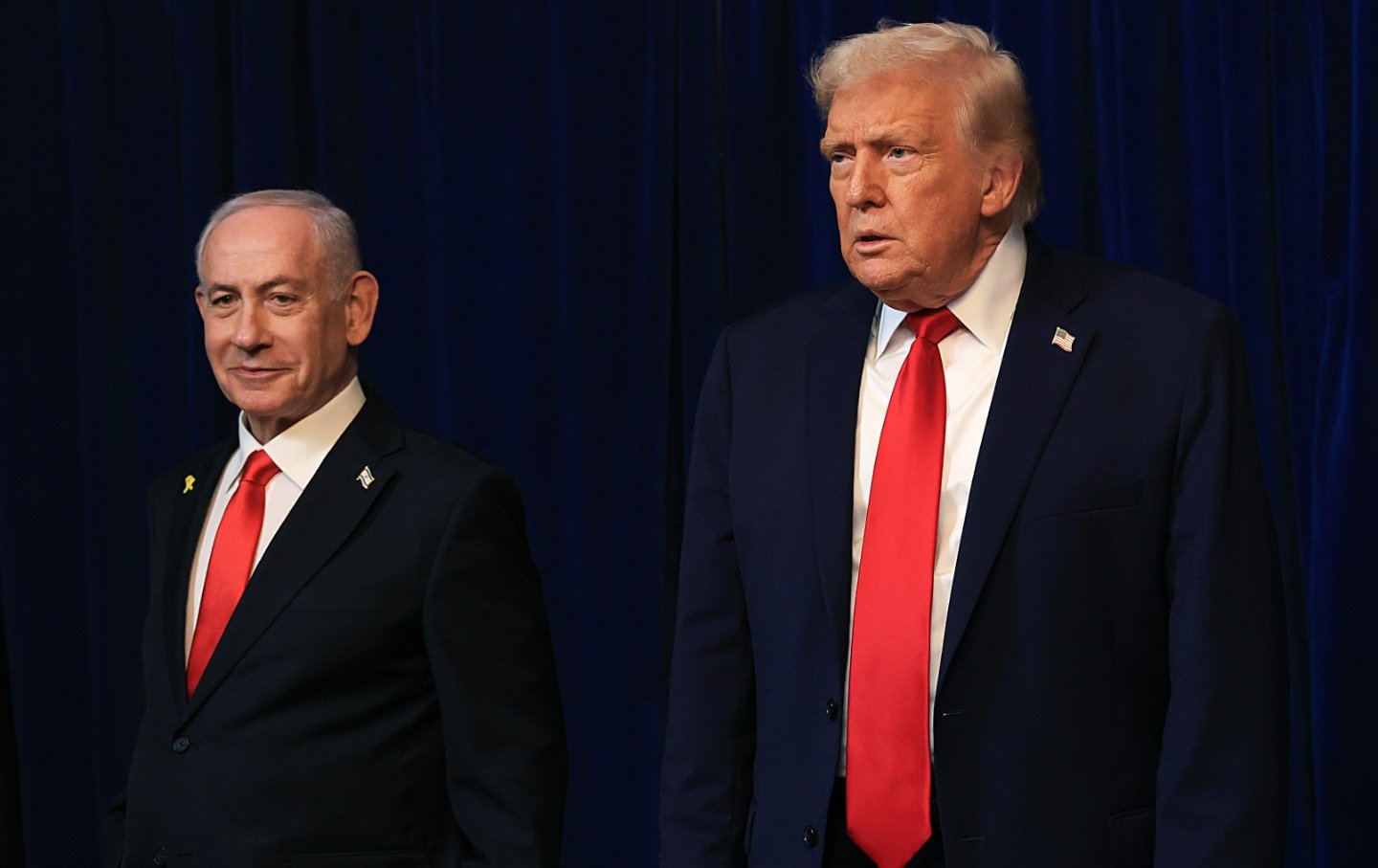
President Donald Trump holds a press conference with Israeli Prime Minister Benjamin Netanyahu at his Mar-a-Lago club on December 29, 2025.
(Joe Raedle / Getty Images)
On Saturday morning, Donald Trump made a brief speech outlining the rationale for the war of choice against Iran that the US and Israel had launched hours before. Amid the rambling, one motive seemingly became clear: regime change. With typical grandiosity, Trump intoned, “Finally, to the great proud people of Iran, I say tonight that the hour of your freedom is at hand.… When we are finished, take over your government. It will be yours to take.”
Yet, the following day, Trump told The Atlantic that he was open to negotiations with the government he’d just said he wanted to remove. “They want to talk, and I have agreed to talk, so I will be talking to them,” he said.
It’s hardly surprising that someone as erratic and mendacious as Trump is talking out of both sides of his mouth, even on something as serious as a regional war. His Saturday speech was filled with contradictions. He claimed, for instance, that Iran’s nuclear program had been “obliterated” and then said “it will be totally again obliterated.” The phrase “again obliterated” neatly encapsulates a foreign policy with no regard for either facts or logic—which is presumably one reason why mainstream outlets such as The New Yorker and The Atlantic are signaling their skepticism about Trump’s war.
If Trump’s interview with The Atlantic is anything to go by, the president seems to want a reprise of the so-called Twelve-Day War the United States and Israel launched last June: a short display of US/Israeli military prowess designed to cow the Iranians into yielding during negotiations. This might be described as Trump’s minimum agenda, but it is combined with other contradictory goals that are much more dangerous and far-reaching. Mixing “the art of the deal” with “the art of war” is not a simple proposition. Wars have a way of spiraling out of control—particularly when one side makes incendiary moves, such as the unprovoked assassination of Iranian Supreme Leader Ayatollah Khamenei, that all but invite scorched-earth reactions.
But as with so much of Trump’s agenda, the chaos is perhaps the point. Maybe Trump was willing to join in a war that had been advocated by Israeli Prime Minister Benjamin Netanyahu over the last four decades because, for many advocates for this war, the prospect of Iran’s collapsing into turmoil and becoming a failed state is a welcome one.
One notable feature of the two wars Trump has launched has been the assassination of not just top Iranian leaders such as Khamenei but also opposition leaders and dissidents. The fact that the US/Israeli attacks have led to the death of opponents of Iran’s theocracy points to a dire conclusion: that the goal of these wars is not just regime change but regime obliteration, destroying the possibility of Iran’s functioning as a coherent polity in the future.
Current Issue

On June 23, 2025, Israel bombed Evin Prison, known to house political prisoners. As Human Rights Watch noted, the bombing included “prison areas known to hold many activists and dissidents.” In the current war, the same targeting of opposition figures can be seen. As international relations scholar Van Jackson, who teaches at Victoria University of Wellington, observed,
There are claims circulating widely on social media that Israel has been targeting leftists in Iran, in hopes of destroying any coherent political force from cohering in the country. Israel has also definitely targeted the building where the leader of the Green Movement, Mir-Hossein Mousavi, has been under house arrest since 2011, which would further support that claim.
The attempted assassination of Mousavi is particularly telling, since he helped lead the Green Movement uprising of 2009 and has been under house arrest. Mousavi could be a leading figure in any peaceful Iranian transition to democracy, an outcome that the US and Israel seem to want to forestall.
Aaron Bastani, cofounder of Novara Media, points out that the attacks have also been killing border guards along the Iraq/Iran border, which would make it easier for separatist groups to smuggle in weapons. “Killing this many border guards is a clear signal,” Bastani points out. “It is about separatism, balkanization and rendering Iran a failed state.”
Israel and the US are barely hiding this agenda. Axios quotes an Israeli official as saying, “The goal is to create all the conditions for the downfall of the Iranian regime.” Axios adds that “Israel is targeting the entire Iranian leadership—political and military, past, present, and future.” (The “future” part is most concerning, since it suggests a goal of making sure no faction, of whatever political orientation, takes over a unified Iranian state.) And Trump admitted as much when he told ABC News that the people the US had identified to possibly take over leadership of Iran had all been killed over the weekend. “The attack was so successful it knocked out most of the candidates,” he said. “It’s not going to be anybody that we were thinking of because they are all dead. Second or third place is dead.”
This goal of regime collapse is more an aspiration than a clear plan. Trump himself is mercurial and easily cross-pressured. It’s easy to imagine a set of circumstances forcing him to beat a hasty retreat: rising US casualties, rising oil prices, and the pleading of Arab autocracies such as Qatar and the United Arab Emirates (currently facing fierce Iranian attacks).
But even if regime collapse fails, this war will cast a long shadow in the future. Iranians of all stripes, not just supporters of the theocracy but simple nationalists who want a unified polity, will rightly distrust the US. After the death of Khamenei, there is every reason to think (as CIA analysts suggest) that power will increasingly fall to hard-line nationalists inside the Islamic Revolutionary Guard Corps.
Like so many of Trump’s endeavors, the current war is half-baked and badly conceived. Trump was hoping for a variety of implausible scenarios—either a quick Iranian capitulation leading to a return to negotiations or regime collapse. More likely, he’s planted the seeds for future strife in ways that are impossible to predict but still terrifying to contemplate.
More from The Nation
We need to listen to those who oppose both the Islamic Republic’s authoritarianism and foreign military escalation.
Boris Kagarlitsky and hundreds of unknown political prisoners remain in Russia’s prisons.
The secretary of state has provoked the ire of Britain’s first black woman lawmaker and put the spotlight once again on how the US has historically treated people of his own herit…
