Jon Wiener: From The Nation magazine, this is Start Making Sense. I’m Jon Wiener. This is our year-in-review show: later in the hour, the year in court: David Cole, who stepped down this year as National Legal Director of the ACLU, will comment on the 150 rulings against Trump in federal courts this past year, and the 21 times the Supreme Court has supported his attacks on democracy. But first: the year in politics – Harold Meyerson has our analysis – in a minute.
[BREAK]
Now it’s time for our Year in Review: Politics in 2025. For that, we turn to Harold Meyerson. Of course he’s editor at large of The American Prospect. Harold, welcome back.
Harold Meyerson: Always good to be here, Jon.
JW: The basic story of politics in 2025 is pretty simple: On the one hand, Trump’s attacks on democracy, unprecedented in the last century at least; and on the other hand, the rise of opposition from the majority, and of widespread and well-organized resistance.
Although Trump won the popular vote by a narrow majority, his approval ratings fell steadily. January 20th, when he took the oath of office, he started at around 48% approval. Most presidents have a honeymoon period in their first year, not Trump. The AP today has him at 36% approval. Other polls have him a bit higher. No other president has seen his approval ratings sink so low, so quickly. Trump is the most unpopular president in American history, at least the history of polling, after one year. What were the most important causes of this massive popular opposition to Trump?
HM: Well, I think as a general point, we should remember that when Trump is out of office and a candidate who is simply slinging accusations at whoever is in power, that’s when he brings out a particular segment of the sometime voters who just want to stick it to whoever is in power and the establishment. Not that they don’t have legitimate grievances too, but every time he’s been in power during his first term, the midterms of 2018, the presidential election of 2020, and now that he’s returned, what we can see in his pulse, people don’t actually like what he does as president. He’s a bully, he’s cruel, he’s self-absorbed. I mean, just in the last 10 days, we’ve seen his name slapped on the Kennedy Center, the US Institute of Peace, and now an entire new class of battleship. He’s sort of an unlikable megalomaniac who brings a certain amount of racism and a priori cruelty to what he does as president. So that’s not a basis for sustaining popularity.
JW: And then there’s the cost of living.
HM: And then there’s the cost of living, which is what has swung the voters who swung to Trump in 2024, according to the polls, particularly Latinos and young people, to disenchant and disenthrall themselves from him. The economy is going on what’s now called a K-shaped track in which the most affluent 10% are now doing half the consuming in America. Whereas when I was a young fellow and you were a young fellow, it was 30%. And the other 90% is struggling with housing and care for seniors and care for kids and healthcare generally and college tuition and all of life’s essential. So that’s not a basis for sustaining popularity either.
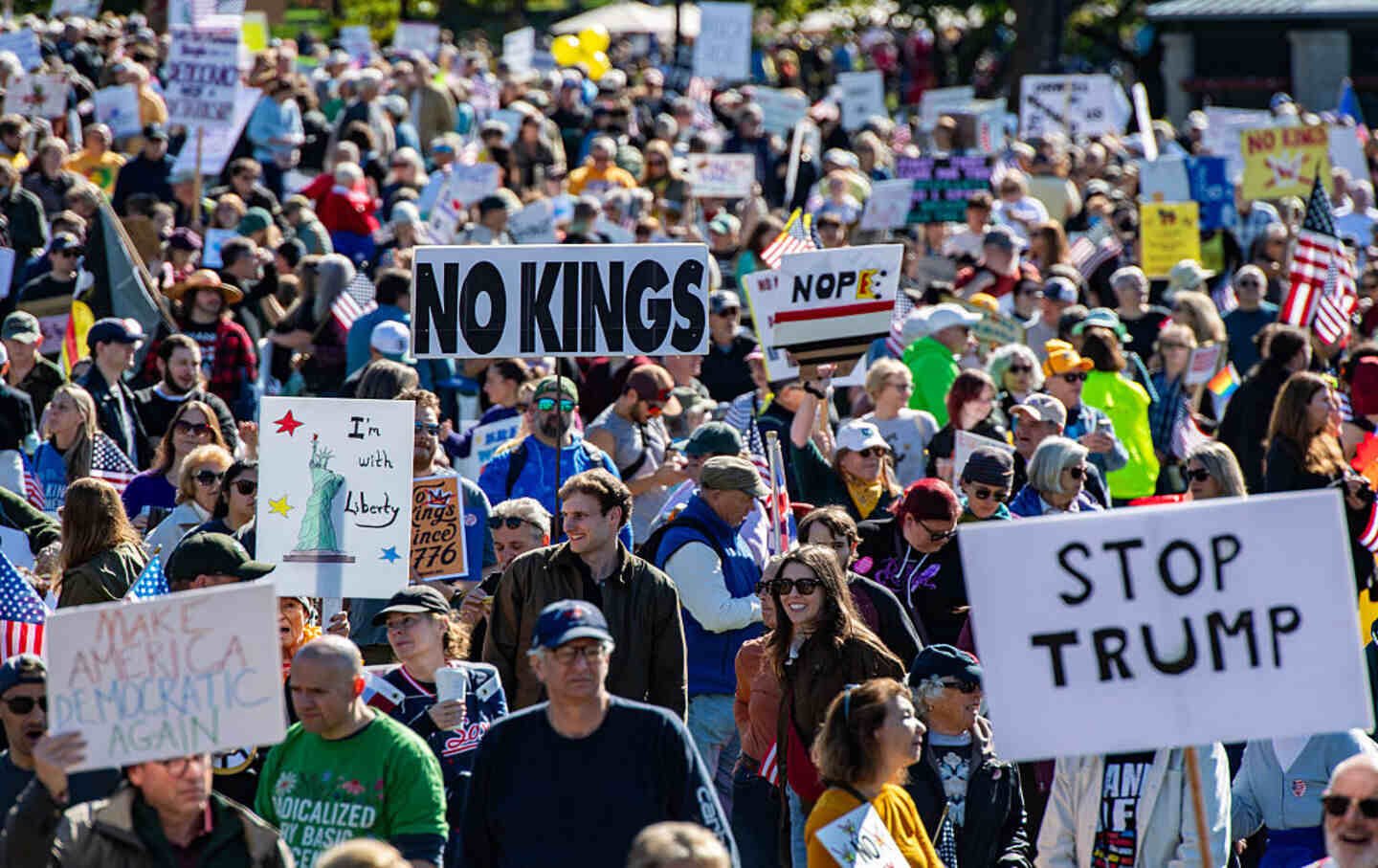
JW: And the other historical political event this year included the huge anti-Trump mobilizations organized by Indivisible. The biggest protests in American history by some measures, there was the Hands-Off demonstrations in April, the No Kings mobilization, the first one in June, No Kings number two in October, the first had three million people, the second had five million people. Then the No Kings two on October 18th had almost seven million people, probably a record for one day of protest across American cities. These were wonderful events, and they were historically one of the most politically important events of 2025.
HM: They were. And sort of as the compliment to this, there were the neighborhoods that rallied in support of the families and the communities that were completely disrupted by Trump’s deportation policies, which is somewhat analogous to the spontaneous protests that arose in northern cities when slave hunters tried to avail themselves of the Fugitive Slave Act.
JW: You’re referring to the 1850s.
HM: I am referring to the 1850s, yes. When we saw what I think is analogous to the neighborhood turnouts and alerts that are now part and parcel of the protests, we have the very large-scale protests that you alluded to, and we have the protect the community, protect the family protest against Trump’s deportation goons.JW: Yeah. I looked up some of the statistics on Trump’s deportation regime, which of course is one of the most important stories of 2025. Trump here is, of course, following the plans of Stephen Miller. He said his goal is to deport 15 million people. And of course, Trump sent ICE agents and then the National Guard into Los Angeles and Chicago, Washington, DC, now other places. But the resistance in all of those places has been fierce, as you say, and sustained. There are these rapid response networks at work every day in key cities which report and monitor ICE movements. There were dozens of organizations that distributed millions of Know Your Rights cards and did thousands of Know Your Rights trainings.
And the result is that they’ve been unable to deport anything like the number of people Stephen Miller has dreamed of. The best estimate of the number of people deported this year is around 600,000. That isn’t very different from the number that Biden deported in his last year. But of course, there’s a big difference between the people Biden deported and the people that Trump has deported, and that explains a lot of the resistance.
HM: Yes. Every survey of those who are deported shows that the vast majority have not been accused, let alone convicted of crimes, let alone violent crimes, which is the ostensible cover for what the Trump administration says it is doing. While there’s always been majority support for controlling the borders and Trump retained support for that, the deportation policy itself is clearly a major factor in his declining overall popularity.
JW: And there’s another key piece of evidence of his declining popularity, and that comes in elections, 2025 was a year of elections. And as far as I can tell, Republicans lost every election of 2025, starting at the beginning of the year with the Wisconsin State Supreme Court, where Elon Musk spent millions of dollars and personally campaigned for the Republican candidate. There were special elections in many places for the House and for state legislatures. There was the Pennsylvania Supreme Court had an election which Democrats swept. Democrats swept the governorships of Virginia, New Jersey, big victories, and of course, a Muslim socialist was elected mayor of New York City. So in 2025, democracy in terms of voting in elections was thriving this year.
HM: And if there’s one election that shows just how out of kilter, not just Trump, but the Republicans are, it’s the election of two Democrats to Georgia’s Public Power Commission, which was in many ways a revolt against the Trump economy and the high electrical prices, which are also related to the massive amount of power being swept up by the data centers, created essentially by the tech oligarchs who Trump has proved very loyal to, at times, alienating any number of MAGA stalwarts for that, like Marjorie Taylor Green and others.
JW: Elise Stefanik.
HM: Elise Stefanik, who demonstrated just in case anyone needed to have it demonstrated that loyalty to Trump, no matter how debasing you are to yourself, need not be reciprocated by Trump, who was never particularly interested in what other people do or feel so long as he can come out in his own view on top.
JW: And one more big story of 2025, of course, we should talk about Trump’s attack on democratic institutions across the board, on the federal agencies that help people and on the organized sources of opposition to his rule in civil societies, attacks on the news media, on the legal profession, and on the universities.
HM: What we’ve seen is a lot of elite institutions caving instantaneously. I think the law firm of Paul, Weiss, which actually had some of the creators of the New Deal in its full name, Wharton Rifkind and Garrison, Cy Rifkind had been a general counsel for Robert Wagner who authored the Social Security Act and the National Labor Relations Act. That’s kind of set the template for a number of really cowardly university boards of trustees and other law firms and so on. And of course, part of the problem is that Trump uses his administration and the regulatory commissions he is taking over, the Supreme Court has yet to fully rule on that, but there are days that even ostensible independents are coming to an end, to threaten anyone who needs some approval from the government. And so that’s been fairly effective, but some of the universities have pushed back. And even when the universities haven’t pushed back, sometimes their faculty and student unions have pushed back. So that’s a mixed bag.
As far as the courts go, you’re right that the lower courts generally have been receptive to the challenges to Trump’s arrogation of power, which the Constitution doesn’t actually vest in the presidency.
The Supreme Court has yet to formally rule on tariffs, on independent commissions, though that handwriting is on the wall on that one. And birthright citizenship, which are three of the big cases Trump has essentially put before the court. If they uphold Trump’s position on birthright citizenship, that would be an earthquake and that would be surprising. But this is a very partisan court in part, certainly some of the Republican justices. And so that’s going to be part of the story of 2026, what the court does there.
JW: And what about the news media, which supposedly are independent checks on the power of government misconduct?
HM: That too has been a real battlefield. Public supported media like PBS and National Public Radio in particular have been the targets of Republicans for a long time, but not to the degree that they’ve been the targets under Trump. NPR has been cast into the no federal fund’s darkness. In terms of other media, we have seen the takeover of CBS News by right wingers, blocking a story on 60 Minutes about the prisons in El Salvador to which Trump’s deportees have been sent. MSNBC has been cast off from NBC and is now its own entity. So there is some caving on the media front and—
JW: Any comment on the state of The Washington Post or the other legacy print media we’re supposed to call them?
HM: Well, The New York Times, which is the most successful entity of the legacy print media with more than 10 million subscribers when you factor in digital subscribers, has been pretty good. Although its initial resistance bordering on not exactly very good coverage of Zohran Mamdani was certainly an obstacle Zohran Mamdani had to overcome. He more or less did. He clearly did in terms of his victory.
The Washington Post, while Jeff Bezos is still the largest shareholder in Amazon and he doesn’t want the Fed screwing around with Amazon. So The Post completely sacked almost all of its opinion writers and brought in kind of The Wall Street Journal b-team to control its editorial pages.
JW: But its news pages–
HM: Its news pages remain pretty good, as does The Times. The Wall Street Journal news pages have always been pretty good and remain pretty good even now. The LA Times has sort of shrunk to its husk, but they have occasionally very good stories as well and don’t run editorials anymore. The billionaire owner of The LA Times, that’s his way of trying to pretend that he doesn’t have to take a stand on anything and hope he can sort of whistle by the Trump graveyard. So that too is a mixed picture, but there’s still a lot of very conscientious and very able reporters dealing with what is the target rich environment of Donald Trump’s administration and the MAGA movement, which backs it up.
JW: I would just say one other word about the universities, Trump has singled out Harvard among the elite private universities, and UCLA among the best public universities, for special torment and punishment. Neither of them have bent to Trump’s will. Their official leadership has not been outspokenly defiant. They have chosen a quieter form of resistance. But unlike many universities public and private, neither Harvard nor UCLA has agreed to any kind of deal to pay off the Trump administration to leave them alone. And we hope they will continue that role in the future.
One final development in 2025 that we need to review: Trump’s own mental and psychological deterioration. A lot of people have pointed out he’s gotten more megalomaniacal, more unhinged, more corrupt, more grandiose, more impulsive, more irrational, and frankly more self-destructive over the course of the last 11 months, all of which makes him probably more dangerous.
I know you have not been so eager to say that Trump is going mentally downhill fast, but certainly a lot of other people say that.
HM: Well, again, I don’t know how much deterioration there is, but he was damaged goods to begin with. I mean, I have a piece about his naming-things-after-himself mania, which just in the last 10 days or so has included the Kennedy Center, the US Institute of Peace, and now a new class of battleships, the ‘Trump class’ battleships. I suggested in this piece that we don’t have to confine ourselves to letting Trump name things after himself in the federal government. We are patriotic Americans. We can name things after President Trump. Cities can name their sewer systems after President Trump. People can put post-its on public toilets, naming them after President Trump. There’s a host of opportunities for freedom-loving patriotic Americans to get with the zeitgeist and name things after President Trump.
JW: Modest proposals from Harold Meyerson with our year in review. You can read him at Prospect.org. Harold, thank you for all your work this year, and thanks for talking with us today.
HM: It’s been great talking to you this year, and I look forward to doing it next.
[BREAK]
Jon Wiener: 2025 has been a year of resistance to Trump, including in the courts, where Trump’s attacks on democracy have been repeatedly challenged. For comment and analysis, we turn to David Cole. He’s the former National Legal Director of the ACLU who now teaches law at Georgetown. He also writes for The New York Times, The Washington Post, and The New York Review, and he’s The Nation’s legal affairs correspondent. David, welcome back.
David Cole: Nice to be with you, Jon.
JW: Let’s start with the big news from the Supreme Court last week: by a vote of six to three, they refused to allow Trump to deploy National Guard troops in Chicago over the objection of the Illinois governor. This was just a preliminary ruling, but it does suggest that similar deployments in other cities are also illegal. He started in Los Angeles last June, then Portland and elsewhere. This is probably the most significant case where the conservative majority did not support Trump’s claims to power. Tell us about that case and its significance.
DC: Yeah, I think it’s a huge decision. It basically stops Trump’s sort of National Guard theater around the country, in which he’s calling out the guard ostensibly to support law enforcement in cities and states where law enforcement is doing the job it needs to do and has not asked for any assistance. And what the Supreme Court said was that the statute that he asserted that allows him to federalize the National Guard, take National Guard troops away from the state governor who oversees them and direct them himself, can only be deployed where regular troops have failed to do the job in executing the law. And there’s two problems for Trump on that ground. First, he hasn’t tried to bring in regular troops, namely the actual military. And secondly, the reason he hasn’t is because regular troops are forbidden from executing the law, except where Congress has expressly authorized them to do so.
And he has not invoked any statute that expressly authorizes the use of regular troops. And so until he does that and uses regular troops and they’re unavailable, only at that point is he allowed to federalize the National Guard. The Guard is supposed to be governed by the states, not by the federal government.
JW: This ruling suggests that not only is Trump banned from using the National Guard to pursue his deportation agenda in the blue states where the governor objects, but also, many of our friends are worried he might have used the Guard on election day this November, when he might send the guard to polling places in blue cities to try to intimidate voters. Do you agree that this ruling also prohibits that?
DC: Absolutely. Absolutely. There’s no authority for Trump to invoke the National Guard unless two things happen. One, that there’s authority for him to use regular troops, and that’s a very narrow set of circumstances, and it does not include election intimidation or election fraud or anything like that. And second, he has to first use troops and show that they’re unable to do the job, and only then can he bring in the National Guard. So I think this takes the National Guard off the table — with the exception of my fair District of Columbia, which is a federal enclave, and so he has broader authority here.
JW: Trump has said he might invoke the Insurrection Act, which does give him the power to use troops to enforce civil peace. Of course, we think there’s a difference between insurrection and protest.
DC: Yeah. The Insurrection Act is designed to deal with acts of armed rebellion where the state is either unable or unwilling to put down the rebellion. That is the first line of response to any kind of unrest is supposed to be in the states and only where the state government is behind the insurrection of rebellion, or the state government has been overwhelmed by the rebellion, can the Insurrection Act legally be invoked? Does that mean Trump won’t invoke it short of circumstances like that? No, but I think it does mean that courts will be very, very skeptical and ought to be very skeptical of invoking it absent those kinds of circumstances, which just have not been present.JW: I want to pull the focus back to the year of challenges in court, which actually began on the very first day of Trump’s second term, January 20th. He started signing executive orders. That day he signed a couple of dozen, and he signed more than a hundred, maybe 200 since then. These, of course, had been in the works for a long time. They mostly came from the Heritage Foundation’s Project 2025.
And the state attorneys general of the blue states along with the ACLU and its allied groups had also been planning for this moment for a long time and responded also starting on day one, January 20th, filing legal challenges to Trump’s executive orders. And those challenges have mostly succeeded in the lower courts.
The most recent one came just this week when a federal judge in San Francisco temporarily blocked ICE from arresting people when they show up for their scheduled hearings at immigration court. Now, this is limited to Northern California and Hawaii, but it will certainly be litigated through the Ninth Circuit and probably up to the Supreme Court.
As of today, there have been something like 150 of Trump’s executive orders and actions that have been blocked by the federal courts, either partially or fully by temporary restraining orders, by preliminary injunctions, sometimes by rulings on the merits. And even Republican-appointed district judges, even Trump-appointed judges have ruled against administration policies. 64% of the time that these cases have come before Republican judges, they have ruled against Trump. How do you explain the broad success of these 150 legal challenges?
DC: Trump is acting in ways that are really unprecedented, that are often directly in violation of fairly foundational legal principles, and judges are just doing their job, which is to enforce the law against anyone who violates it, even if that person is the most powerful person in the United States.
JW: Then we get to the Supreme Court. It hasn’t taken up very many of these 150 challenges. It has stayed or reversed lower court rulings against Trump 20 times out of 24 decisions. Now, the great majority of these were not on the merits. They were part of the shadow docket. They were temporary stays. The cases are yet to be decided by argument in open court with written decisions. What’s your comment on the court reversing 20 out of 24 of these lower court rulings?
DC: Well, I think it’s not encouraging, but I also think people often read too much negativity into that statistic. You have to keep in mind that it’s only 20. As you said, 150 injunctions against the President, that’s because the President has not taken a lot of those other injunctions up to the Supreme Court. Why? Because he knows he would probably lose them there. So that’s one point. They’ve only appealed on ones where they thought they would win. Second point is they’ve lost in some really important ones. This National Guard one was a huge one. They also lost with respect to the spiriting people out of the country under the Alien Enemies Act. That has been stayed until the Supreme Court determines whether it’s lawful or not. They stopped his effort to kick Lisa Cook off the Federal Reserve, and they also ordered him to facilitate the return of Mr. Ábrego García, an El Salvadorian man who was wrongly deported.
So I think it’s important to note that they have ruled against the president on a number of occasions. They have ruled for the president on a disturbing number of occasions.
JW: Yeah, let’s look at those. What do you think are the most important cases where the court did the most damage to democracy and freedom in the last year?
DC: A number of those cases involve Trump, basically refusing to spend money that Congress appropriated or trying to essentially decimate agencies that Congress authorized. So those are a problem because now USAID basically doesn’t exist. The Department of Education has been decimated. The CFPB, he is trying — that’s serious executive overreach.
JW: For us here in Los Angeles, there’s been one really big loss, which was the Supreme Court’s temporary reversal of the Ninth Circuit ruling that prohibited ICE stops based on racial profiling. They were arresting people basically because they looked Latino or because they spoke Spanish. This was the case argued by Mark Rosenbaum of Public Counsel. It isn’t over. This was a temporary stay of a temporary restraining order, and the underlying lawsuit continues at the Ninth Circuit. But there is a kind of a constitutional question of whether the Equal Protection Clause and the Fourth Amendment requirement of probable cause apply to ICE stopping people because they look Latino or because they’re speaking Spanish. And right now, ICE is doing it again in Los Angeles and everywhere else. And that’s on our list of the big losses.
DC: No, that is a big loss to be sure. Again, because on these emergency docket rulings, the court often doesn’t explain its reasoning. You don’t know what the basis for it is. In that case, Justice Kavanaugh wrote a concurrence. And so he gave his reasons, which included that he didn’t think the plaintiffs had standing to challenge the ICE actions because you have to show that the action is likely very imminent or very, very likely to happen to you in the near term future without the relief. And when you’re talking about challenges to law enforcement actions, it’s hard to say that with respect to any particular plaintiff that they will face that law enforcement action in an immediate sense, in an imminent sense that provides standing. That would not be a ruling on the merits. He also went on to say that factors like speaking Spanish or national origin or appearance and the like can be factors in ICE going up to someone and stopping them for a Terry stop for reasonable suspicion.
The court held that about 25 years ago in another case. So that wasn’t really breaking new ground. So I think what ICE was doing in LA and continues to do across the country is outrageous and despicable and inhumane. But in that particular case, the court didn’t tell us why it was staying the injunction. Kavanaugh pointed to two possible reasons that are basically based on existing law, not creating new law.
JW: You’ve suggested there’s been too much negativity among some of our friends and that the coming term may have better results from our point of view because the court has not yet taken up the biggest cases. Let’s talk about those.
DC: Tight now, the court has heard argument in the challenge to Trump’s tariffs and has agreed to hear argument in the challenge to Trump’s executive order on birthright citizenship. I think it’s almost certain that it will rule that the birthright citizenship order is illegal. It is contrary to the plain text of the Constitution and the understanding. It is contrary to a Supreme Court precedent that’s been in place for over a hundred years, and virtually every lower court judge has agreed that it’s illegal. I would be shocked if the court held otherwise. And on the tariffs, Trump’s principle foreign policy initiative, the oral argument suggested that there are at least four and possibly six justices who believe that he has acted unlawfully in imposing tariffs, that he has taken on power, that is Congress’s power, that is the power to tax, because a tariff is basically a tax. And he has taken on that power without Congress having given him that power. And as a result, it is quite possible that we come to the end of this Supreme Court term, not the end of this year, but the Supreme Court term, which will end in June of 2026, with Trump losing on two of his premier initiatives in the Supreme Court.
JW: The other big one that our friends are worried about is the issue of the independence of independent federal agencies created by Congress. That is a huge issue for the way America has been governed since the New Deal, and it is very much endangered right now.DC: Agreed. That’s one that he will very likely win. They’ve already indicated that they are skeptical of the notion that Congress has the power to impose limits on the president’s ability to remove what are called principal officers, basically the heads of administrative agencies. I think it’s wrongheaded, but this is the direction this court has been going for the last at least decade. It has been striking down efforts by Congress to give a degree of independence to certain administrative agencies. Agencies where you’d want them to have independence like the Federal Reserve, you don’t want it to be controlled by politics or the SEC, we want it to be enforcing the law, not acting in a political way or the Federal Elections Commission or the Merit Systems Protection Board, which reviews claims against the executive by its employees. Why would you want that office to be removable by the president who is essentially the defendant in all those cases?
And so Congress provided a degree of independence. The president can only remove those sorts of officers if he has a for cause, if he shows that they are not doing their job, they are engaging in neglect, et cetera, but not simply because he disagrees with them on a particular political decision. The court is very likely to say, “no; with respect at least to the top officers in the executive branch, the president has to have the ability to remove them, because otherwise it’s his executive power, it’s his job to faithfully execute the laws. And if he can’t remove them, if he doesn’t like the way they’re executing the laws, then that has intruded on his executive authority.” That is contrary, I think, to the original understanding. It’s contrary to a hundred years of precedent, but it is the direction that this court has been going actually before the Trump justices were added to the court.
So it will come to a close, I think, with a win for Trump in a ruling that overturns a case called Humphrey’s Executor from about 90 years ago that said that where government agencies are engaging in sort of quasi-legislative and quasi-adjudicative actions, it is permissible for Congress to put limits on the president’s ability to remove them.
JW: Big picture, some of our friends, especially Elie Mystal at the nation, have a very dark view of our future because of the actions of the Supreme Court. I know you’ve debated him or had public discussions with him about this. His view is basically the court majority is committed to supporting Trump. So it is a delusion to think that the courts are going to protect us from Trump. You don’t agree with Elie Mystal’s view of the value of litigating issues given the present state of the Supreme Court. Why not?
DC: Yeah. Look, I don’t wear rose-tinted glasses. I recognize that the court consists of six very conservative justices and three liberal justices, and that makes those who are liberal sort of at a disadvantage in any politically charged case before the Supreme Court. However, what is the alternative? What is the alternative? You’re not going to get any meaningful check on the president from Congress. We’ve shown that’s absolutely clear. And when you’re representing people who are being put on a plane to be sent to El Salvador to a torture prison, what are you supposed to do? Turn the other cheek, and let them be flown out of this country illegally, because you’re skeptical about the Supreme Court? Or do you do everything within your power to protect those people? And I think it has to be the latter. And in that case, the rulings have stopped that particular action.
And in the National Guard cases, the rulings have stopped President Trump’s blatantly illegal effort to put National Guard on the nation’s city streets for his own dramatic political theater.
So we can win in the courts. Many, as you opened this show, over 150 lower court judges have issued injunctions against President Trump’s initiatives. Many of them have not been appealed to the Supreme Court by the Trump administration. That means those injunctions are in place. They are protecting people as we speak.
So do I think the Supreme Court will save us? Absolutely not. Do I think we should give up on the court? Absolutely not. We need to fight with every tool in our toolkit, and one of those tools and an absolutely critical tool, and one that we ought not lightly give up in the name of some kind of skepticism is suing the bastards when they violate the Constitution.
JW: David Cole — he’s legal affairs correspondent for The Nation and former national legal director for the ACLU. David, thanks for all your work, and thanks for talking with us today.
DC: Thanks, Jon.
