Jon Wiener: From The Nation Magazine, this is Start Making Sense. I’m Jon Wiener. Later in the show, we feature some special songs for the season: Bob Dylan’s Christmas album. “Bells are ringin’, children singin’, all is merry and bright” — later in the show. But first: Los Angeles versus Donald Trump: Bill Gallegos has that story – in a minute.
[BREAK]
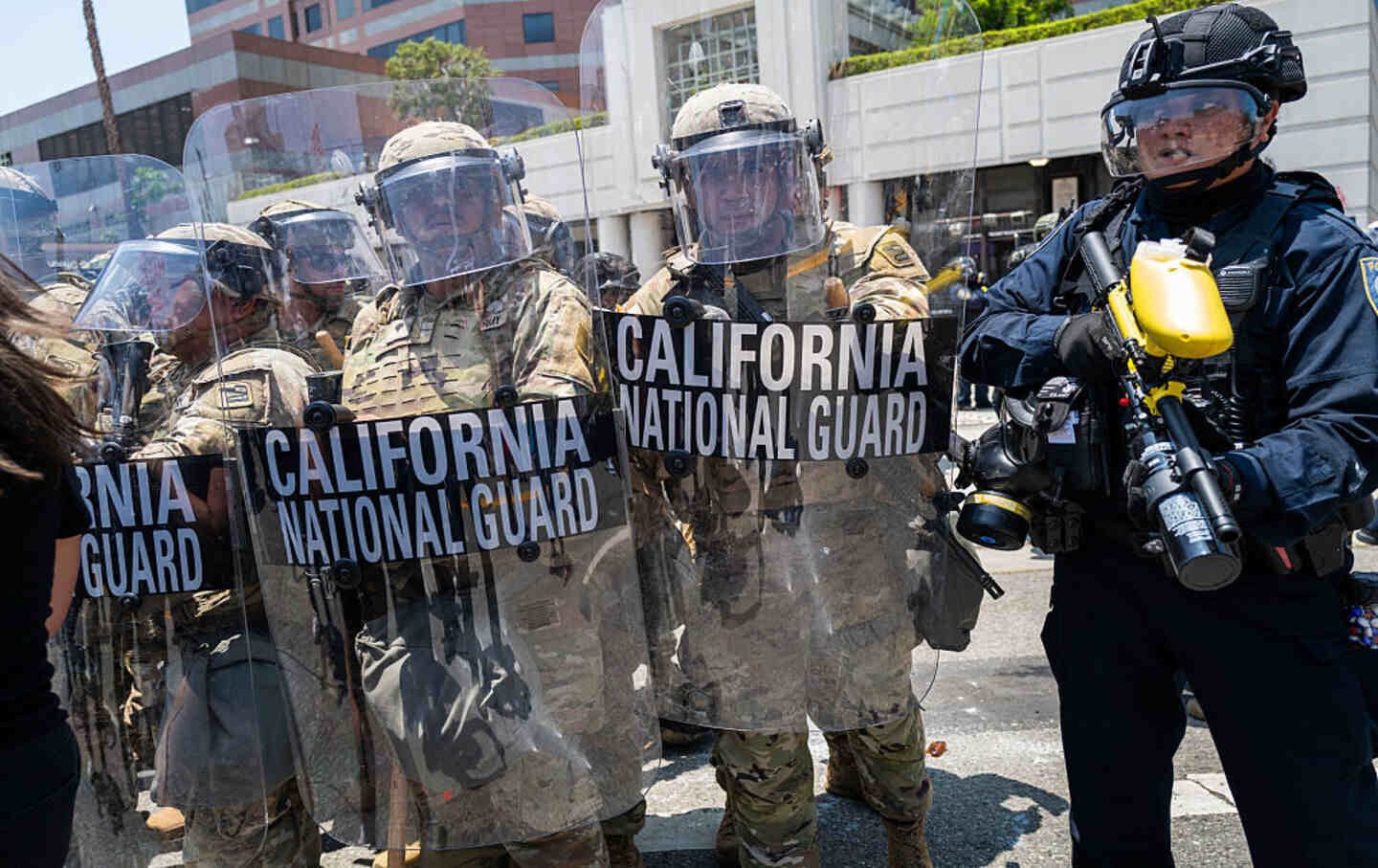
JW: One of the most important chapters in the history of 2025 is the story of how LA defeated Donald Trump. In June 2025, he sent more than 4,000 National Guard troops and 700 Marines to occupy the city and terrorize the immigrant population. But by the end of July, almost all the Guard and the Marines were gone. For the story of how that happened, and what we can learn from it, we turn to Bill Gallegos. He’s the former Executive Director of Communities for a Better Environment, CBE, the California environmental justice organization. He’s also a longtime Chicano activist, and he’s a member of the editorial board of The Nation. Bill Gallegos, welcome to the program.
Bill Gallegos: Thank you, Jon. I’m so glad to be here with you.
JW: You say Donald Trump hates LA. Why is that?
BG: Well, he’s not exactly a hard person to figure out. He hates places that are strongly opposed to him, and this is a super blue city and county. He doesn’t seem to like Black and Brown folks, and we’re a majority-minority city and county. And he’s not a friend of unions. We have a pretty strong labor movement here, and I want to just give a shout out to our dearly departed Kent Wong from the UCLA Labor Center. And we are a city with a large immigrant population. So this was a city that made a lot of sense from the standpoint of really unleashing his ICE brigades, his thugs, and sending in the troops. But it’s also proved to be a center of remarkable resistance.
JW: Governor Gavin Newsom and Mayor Karen Bass denounced Trump sending the Guard and the Marines to LA right away. The state sued the president, won a string of victories in federal court. But it was the mobilization of thousands of people in a fierce and effective local opposition movement that also played a decisive role in defeating Trump. And that’s our main focus today, because that’s what offers a lesson for communities across the country. We’re speaking in LA. ICE was raiding workplaces around the city, to round up and detain people whose crime was that they looked Latino. They were doing this at the Garment Center downtown, at carwashes around the city, and in the parking lots of Home Depot stores where day laborers gather looking for work. But we can pinpoint the day things started to change. You say it was June 6th. What was the spark that lit the flame?
BG: When they assaulted Labor Leader David Huerta, the president of the California SEIU, the Service Employees International Union, that really turned the tide.
JW: Just to fill in what happened here: hundreds of protesters had gathered downtown LA after ICE conducted raids at different places in the city. So there was this confrontation, and David Huerta, the president of SEIU California, was tased, pushed down by ICE agents, hit his head on the ground, then they charged him with felony conspiracy and jailed. That was the event that was the spark.
BG: For all the weaknesses of our labor movement, it’s still our largest social movement, a large sector of people of color, of women, all the sectors from social movements that are so important to the resistance. So when labor came out, that sends a message to the media. It sends a message to elected officials. It sends a message to folks who are in unions — teachers, janitors. My son works at the UPS warehouse, my other son is a tech for Southern California Gas Company. They’re all union. So they were affected: If they can do this to David, they can do this to anybody.
JW: And let’s just say the SEIU is one of the biggest two or three unions in the whole state of California.
BG: That’s correct. Not only a large union, it’s very robust in politics.
JW: So the mobilization of the unions was a key moment here. But there were other well-organized groups that had been working on immigrant rights for a long time.
BG: Jon, one of the things that makes me very proud about Los Angeles is we have a deeply rooted worker center movement. The Korean Immigrant Workers Alliance, Filipino Workers Center, Black Workers Alliance, IDEPSCA, which organizes day laborers, the Garment Workers Center. And the labor centers in Los Angeles renewed May Day, about 15 years ago, they said, “We’re going to go out for May Day.” And they expected a few thousand people, and they got about 15,000 people out in the streets. And it just energized, again, the workers’ movement here — because it’s not just a union movement, it’s a workers’ movement.
JW: And there’s one other important element in this resistance movement, and that is the faith community.
BG: That’s correct. So Clergy and Laity United – CLUE — has been around for a long time and done remarkable work bringing different sectors of the faith community together to support social justice, environmental justice, and worker justice, especially. And they were immediately out there, before the cameras were on, before the microphones were out. They’d been out there opposing ICE. Of course, the AME Church in South Los Angeles has been a leader in all of our political and social movements here in Los Angeles, and they played a very, very big role.
At a time when there’s been some tension in the faith community because of Gaza, there was a lot of common ground here–Jewish, Islam, all of the different faith sectors have come together in a remarkable show of support. And finally, the Archbishop of Los Angeles spoke out and says, “This is wrong, and you can’t do it.”
JW: And there are millions of Catholics in Los Angeles.
BG: Absolutely. The Catholic church is largely immigrant in California.
JW: All these organizations and groups worked together: they did thousand of Know Your Rights trainings, and distributed millions of Know Your Rights cards, they built Rapid Response Networks to monitor and report on ICE movements. For those who were detained, they provided legal aid and lawyers. They ran food drives and organized mutual aid efforts for immigrant families; and public schools and teachers unions organized to protect students from ICE.
You say in The Nation that the legal battle was equally important. Governor Newsom sued the Trump administration in June 2025, right away, over its deployment of the National Guard. Several other organizations also went to court. What were the key groups that led in the legal battle alongside the State Attorney General Rob Bonta?
BG: Well, there’s the American Civil Liberties Union. Started organizing even before the elections, in preparation, because they knew Trump 1 was a very important battleground in the judicial area. So a lot of these organizations, the ACLU, the Mexican American Legal Defense and Education Fund, the NAACP Legal Defense and Education Fund, a lot of the legal immigrant rights organizations, all came together and they were ready. So this was really important, not only in putting a stop to some of the more outrageous actions of the Trump administration, but it also gives us time and space for our organizing. So sometimes, even when it has to work its way through the courts, if there’s a temporary injunction that holds things up, that’s very precious time for us to organize and reach people.
JW: I would mention one other organization, Public Counsel, where Mark Rosenbaum argued in federal court that ICE was detaining people without the required “reasonable suspicion.” Mainly the argument was ICE was stopping people because of their race, ethnicity, or language. In other words, ICE was detaining people because they looked or sounded Latino.The district court agreed with this, the Ninth Circuit agreed with this, and issued and supported a temporary restraining order. That was in effect until September when the Supreme Court lifted that TRO with an emergency stay. That was not based on the merits of the case. They just sent it back to the district court and now we’re sort of back at the beginning on that. But in the meantime, the argument that ICE is detaining people because they look or sound Latino was the law in California all summer long.
BG: Mark Rosenbaum is one of those guys –we want him to live till he’s 200. He’s always out there in the trenches with us.
JW: And one other group I think we need to mention here as a crucial element to this, surprising to many of our friends: liberal and even the neoliberal Democrats.
BG: Jon, that’s a really important point, I think. Los Angeles is a good example of what resistance can look like and how we build a broad united front. We need to do that on a national level. And one of the issues I know that always comes up is “the Democrats are just as bad” and so on and so forth. And that’s, I think, very faulty thinking. We need a very, very broad united front. And that means we’re going to be working with a lot of folks who we may have differences on a number of even important issues. But right now, the effort to impose a kind of Christian nationalist apartheid state, that should be our guidepost for how we come together.
In this effort to get the troops out of Los Angeles, our elected officials played an important role. The governor, our two senators, our congressional delegation, all the Democrats, not the Republicans, the three or four or five Republicans that we have, our legislature, our school boards, our city council, our board of supervisors, mayors, not just Mayor Bass, but all the mayors of the Southeast cities, they all came out and emphasized that not only did we need to get the troops out, we needed to stop the raids.
And that’s a continuing ongoing struggle. But it makes a difference when all of those forces come together, the faith community, labor unions, worker centers, the inner cities and the suburbs. It’s that all of this came together in a remarkable, I think, display of unity. And Jon, we didn’t do what we often do; there was not the sniping and sectarianism that so often hurts us: “That group has the wrong political line.” We didn’t have that. And I think that’s a sign of our growing political maturity and a recognition of what we’re up against right now.
JW: Your cover story for the January issue of the magazine has key lessons to take away from the LA resistance that could be applied in other cities. And your number one, the really important one is “build on your organizing foundation — the longstanding groups that know how to do this.” You say “you don’t have to reinvent the wheel.”
BG: That’s right. So a lot of our unions, the Hotel and Restaurant workers, local 11, I mean, there’s some that stand out. The UCLA Labor Center and the County Fed trained 1,400 people in nonviolent resistance against ICE. So these folks, they’ve been out there for years doing this work, worker centers, a lot of community organizations, Communities for a Better Environment, I’m going to give a shout out to my old organization, SCOPE and Agenda, groups in South Los Angeles, Community Coalition, Inner City Struggle. These groups have been doing it for a long, long time, and they’re rooted in the sectors where we need to be. The majority of this city, working class people of color, they’re rooted there. They’ve done political education for a long time. They’ve trained thousands and thousands of – we have a cadre of organizers and that they stepped forward first. And then the newer folks could come in and there was something there already. There was an established foundation. I have to say, it was so inclusive. Nobody was turned away. You looked at me cross-eyed 20 years ago — I don’t give a damn. Come on in.
JW: I want to mention one group in particular. You mentioned them briefly earlier, CHIRLA, the Coalition for Humane Immigrant Rights, longstanding immigrant rights group. Trump singled them out as the one LA group he said he was targeting for what he said was “funding terrorism.”
BG: Well, I got to say, first of all, we have to be ready to defend CHIRLA. And I think people have stepped forward, because when they say they’re going to go after somebody, we should take them seriously. And what will hold them off is if they know there’s going to be a fight and they’re going to lose. But I think it’s really what we really need, Jon, I would like to see the County Federation of Labor, maybe a group like the Liberty Hill Foundation, which has some resources, maybe some academics and folks from media convene a strategy discussion. We need a strategy. Resistance is wonderful. We have just amazing tactics at every level. What we need now is a strategy. Where do we need to focus our efforts so we can build our forces and weaken theirs very intentionally? And I think the County Fed, I think is in a position to do that. They have a lot of standing—maybe with the UCLA Labor Center and some of the faith community to really convene that kind of a serious discussion about where do we need to focus strategically.
Because we don’t want to end up like Occupy or even the Black Lives Matter movement, which is now, it’s a few local organizations. It was 20 to 25 million people in the street. But if you don’t have that strategic focus and orientation, it can fizzle out.
JW: You conclude your cover story for The Nation that there was a great success this summer in getting the National Guard and the Marines out of LA, but the struggle is not over.
BG: No, ICE has tried to, I think has, doubled down actually in their thuggishness especially. I mean, “we are not going to be constrained by the Bill of Rights, by the Constitution, by the rule of law. We’re going to just terrorize.” And the idea is not to just terrorize immigrants, but the community in which they’re situated. With those large sectors of community, which are centers of resistance. This means that especially our Democratic Party allies cannot run away from the question of immigration, the topic of immigration, like they did in their last election. They tried to hide, they tried to run and hide, and it left the field open to Trump and Vance and MAGA. So I think we have to be very assertive in advocating for a humane and inclusive immigration policy right now. All those things are possible right now. There are a lot of things are being discussed, and I think some people are kind of coming late to the realization that we face a fascist threat, but better late than never.
And I still hear some folks saying, “We’ll get through this. It’ll be okay. We’ve gone through this before.” No, we haven’t. I’ve been through Nixon and Reagan, as have you. This is qualitatively different.
JW: Bill Gallegos–he wrote the cover story for the January issue of The Nation magazine. It’s titled “How LA defeated Donald Trump–and how the rest of the country can too.” Thank you, Bill.
BG: Thank you so much, Jon.
[BREAK]
JW: This is our Christmas show, and now it’s time for our special Christmas music feature. Our guest is Sean Wilentz. He’s the official historian at the official Bob Dylan website. He also teaches American history at Princeton. He’s written many books, including The Age of Reagan. It’s out now in paperback. We turn to him today to help us understand what the heck is going on with the new Bob Dylan Christmas album. We reached him today in Princeton. Sean, welcome back to the program.
Sean Wilentz: Great to be back, Jon.
JW: I want to start by listening to track one, “Here Comes Santa Claus.” It’s a Gene Autry song, which I have to say is one of the most irritating holiday songs ever written—even before Bob Dylan sang it.
MUSIC:
Here comes Santa Claus, here comes Santa Claus, right down Santa Claus Lane
Vixen and Blitzen and all his reindeer, pullin’ on the reins
Bells are ringin’, children singin’, all is merry and bright
Hang your stockings, say your prayers, ’cause Santa Claus comes tonight.
JW: ‘Hang your stockings, say your prayers’—Sean, what is this? Is this a joke of some kind?
SW: [Laughter] No, it’s not a joke at all. Although you could turn it into one by imagining that the person who’s really singing it is Vincent Price. It gives a certain macabre aspect to the song. So you can look at it that way. You can look at a Bob Dylan song any way you want, but no, no, no. This is all very, very straight. This is Bob Dylan, in many ways, looking back to his own childhood. And he’s singing the songs that he heard as a kid in Hibbing where everybody listened to Christmas music, whether you were Jewish or not. And he’s recalling those times and those songs and that spirit.
JW: And I understand that the album itself is a benefit and that the royalties are all being donated to charity?
SW: In perpetuity, that’s right. The royalties are going to Feed America in the United States, and I think that there’s a group in the UK and there’s another group too, to feed the homeless. Basically, this is Bob Dylan in some ways being the character Pretty Boy Floyd from the old Woody Guthrie song. He’s providing Christmas dinner to the families on relief. It’s just that he’s not sticking up a bank, he’s sticking up his own fans.
JW: Let’s listen to another one. “I’ll Be Home for Christmas.” I have to say, when Bob Dylan sings “I’ll Be Home for Christmas,” you have to wonder: is this a promise? or is this a threat?
MUSIC:
I’ll be home for Christmas, you can plan on me
Please have snow and mistletoe and presents on the tree
Christmas Eve will find me where the love light gleams
I’ll be home for Christmas, if only in my dreams
JW: Bob Dylan, “I’ll Be Home for Christmas.” It sounds like a reason to bolt your doors, Sean.
SW: [Laughter] Well, it’s hard to say what home is for Bob Dylan because he’s on his bus so much of the time. Being home for Christmas is a big deal for him because he’s not on his bus.
But this is part of what the album’s about. That’s a song that was originally recorded by Bing Crosby as were, I think 13 of the 15 songs on this album. It’s his tribute to Bing Crosby, among other things. But in 1943, remember Christmas songs during World War II had a whole different meaning. It was very touching, actually, very moving. It was the music actually that held people together, wondering whether their boys, and in some cases, girls, overseas, would ever come home alive, ever.
So, this is a very moving song. It was moving in the forties. And then after the war, Christmas music became a way to assert, with some aggressiveness, to assert a kind of normality which a lot of people in America hadn’t felt since the beginning of the Depression back in the early thirties.
So he’s trying to recapture that, in part. Recapture that mood, which is bigger than Christmas. Bigger than Christmas in America. It has to do with a specific time in a specific place. And it’s also, as I say, a tribute to Bing Crosby. He doesn’t have Bing Crosby’s voice, but he’s copying Bing Crosby’s phrasing. And I know he admires Bing Crosby’s phrasing, so that’s his chance to do that too.
JW: Let’s listen to another one. Do you want to say anything about this one, “Must Be Santa?” This one includes our own David Hidalgo, the great East LA musician who’s a big favorite of ours here.
SW: Indeed, from Los Lobos. He’s the man. He’s maybe one of the most gifted musicians that Dylan’s ever worked with. “Must Be Santa” is my favorite song on the album. It’s a polka song. It’s basically ripped off from the arrangement of a Texas rock polka band. But it also recalls, again, his Christmastime, because it recalls the great polka bands of the Midwest of the 1940s and 1950s. People like Whoopee John Wilfahrt—his real name. And Frankie Yankovic.
JW: Would you please spell the last name of Whoopee John Wilfahrt, please?
SW: W-I-L-F-A-H-R-T.
JW: Are you sure that this is not one of Bob Dylan’s many pseudonyms?
SW: [Laughter] Like “Roosevelt Gook”? No. I have a photograph of Whoopee John Wilfahrt at the Minneapolis airport, taken at about the same time, about 1948, with his band. And I happen to know a lot about Whoopee John. He was quite a character. When he died, it turned out he had left money in most of the hotels of the Midwest. Stashed away lots and lots of money, and basically hiding it from the feds. And he lived quite a wild life, as you might imagine, by a man named Whoopee John.
JW: Well, let’s—
SW: Which I would never call you, Jon.
JW: Thank you. Thank you for that. Sean Wilentz, the official historian of the official bobdylan.com website. From the Bob Dylan Christmas album – let’s listen to “Must Be Santa,” featuring David Hidalgo of Los Lobos.
MUSIC:
Who’s got a beard that’s long and white?
Santa’s got a beard that’s long and white
Who comes around on a special night?
Santa comes around on a special night
Special night, beard that’s white
Must be Santa, must be Santa
Must be Santa, Santa Claus
Who wears boots and a suit of red?
Santa wears boots and a suit of red.
Who wears a long cap on his head?
Santa wears a long cap on his head
Cap on head, suit that’s red
Special night, beard that’s white
Must be Santa, must be Santa
Must be Santa, Santa Claus
JW: They’re dancing in the corridors here at KPFK. “Must Be Santa,” Bob Dylan with David Hidalgo from the Dylan—
SW: I’m dancing here in Princeton. I’m having a great time.
JW: Let’s listen to another one. Here’s Bob Dylan’s “Winter Wonderland.”
MUSIC:
Wonderland, winter wonderland. Wonderland
Sleigh bells ring, are you listenin’?
In the lane, snow is glistenin’
A beautiful sight, we’re happy tonight
Walkin’ in a winter wonderland
Gone away is the bluebird
In his place is a new bird
He sings a love song as we go along
Walkin’ in a winter wonderland
In the meadow, we can build a snowman
Then pretend that he is Parson Brown
He’ll say, “Are you married?”, we’ll say, “No, man
But you can do the job when you’re in town”
Later on, we’ll conspire, as we dream, by the fire
To face unafraid, the plans that we’ve made
Walkin’ in a winter wonderland
JW: Bob Dylan. He sounds like your grizzled old uncle who’s had a little too much of the spiked eggnog at the family gathering.
SW: [Laughter] I think that’s the point actually, Jon. Actually, there’s the Wonder Bread Singers, the whitest of white bread singers I’ve ever heard there. But you also, listen closely and you hear Donnie Haran on the pedal steel.
I think it’s the first time that “Winter Wonderland” has been done, at least in recent memory, with a pedal steel guitar. Dylan adds always a touch. There are touches of the current Bob Dylan along with what Bob Dylan was hearing when he was seven years old.
JW: This whole project made me think of Dylan’s radio program on the Sirius-XM satellite radio where we see what a connoisseur and scholar Bob Dylan is of these pre-rock, earlier 20th century genres. In a way, this is part of that project.
SW: Very much so. This could be a show from that series called “Christmas.” But the difference is that he sings all the songs. He doesn’t just introduce them.
But in fact, one of the songs, “Must Be Santa,” actually did appear in – I forget the name of the band, but anyway, on his Christmas show from Sirius XM. So yes, there is a similarity. He knows a lot about it. This is an active archive. He’s an archivist among other things, and this album is an example of that.
JW: Let’s listen to another one. Of course, he has to do “Oh, Little Town of Bethlehem.”
MUSIC:
O, little town of Bethlehem
How still we see thee lie
Above thy deep and dreamless sleep
The silent stars go by
Yet in the dark streets shine
An everlasting light
The hopes and fears of all the years
Are met in thee tonight
JW: Bob Dylan’s “Little Town of Bethlehem.” I can only say, there must be some way outta here.
SW: [Laughter] This is not one of my favorite cuts on the album. There are others that are better. “O Little Town of Bethlehem,” not his best performance here. Some of the songs—
JW: Well, you know, we—
SW: Some of the songs just don’t – Christmas produced a lot of interesting, wonderful music, which is why so many people cut Christmas albums. Everybody from Frank Sinatra to Ray Charles to Barbra Streisand. Even the Jews cut Christmas albums, right? Neil Diamond has a new one, even, the second one. So there’s a songbook, a real songbook. But some of the songs are very difficult. This is one of them, actually. And the Christmas song, the famous Mel Torme song is also. You need a real range to sing those songs well. And I’m afraid that this doesn’t quite do it. At least not for me.
JW: We’re speaking with Sean Wilentz. He’s the official historian at the official Bob Dylan website, bobdylan.com.
One thing that strikes me about this music that’s so puzzling, so confusing, so troubling to the Bob Dylan’s fan base: Bob has always made a practice of pulling the rug out from under fans who thought they had him pegged. He spent a lot of his career refusing to fulfill his fans’ wishes. And this is certainly part of that.
SW: You could see it that way. The other thing is this is a cover album. These are all cover songs. There’s not a single Bob Dylan song on here that he wrote. Whenever Bob Dylan does a cover album, it usually means that there’s a change gonna come. He did “Self Portrait,” which got roundly panned, especially by, I don’t know if I can say this on the air, but you’ll remember Greil Marcus’s famous first line of his review in Rolling Stone of that album, which is, “What is this–blank”?
JW: “What is this crap?” But not quite “crap.”
SW: Not quite that, yeah. And then he went on to do “Blood on the Tracks.” Then he did the cover albums in the early 90s, the two folk acoustic albums, “Good As I’ve Been to You” and “World Gone Wrong.” And then next thing, he comes out with is “Time Out of Mind,” which is a whole different thing. So, who knows what’s going to come? Here’s another cover album.
So it’s Bob Dylan trying to—and I actually mean this—it’s him plumbing his depths. He’s trying to find something. He’s trying to locate something in his soul, in himself, in his music, and this is the way he does it, by singing other people’s songs, singing a whole album of other people’s songs. So, it’s interesting for that. You have to watch out for that. The second thing is, this is the first time he’s done a Christian album since “Shot of Love.” In other words, this is a spiritual record. This is about his beliefs. He’s a Christian, of a very weird kind. So you have to see it in that context too. There’s a lot of different ways in which Dylan is – and that also disappointed his fans, by the way, when he went gospel, people thought, “What’s going on?”
JW: ‘Disappointed’ is putting it mildly.
SW: Yeah, people went nuts. Although I think that in retrospect, if you go back and listen to some of those albums, not all of them, not “Saved”—but if you listen to “Shot of Love” again, you’ll be very surprised. There’s a lot of really good music on there.
JW: Well, “Gotta Serve Somebody,” in retrospect does have some strengths.
SW: “Slow Train Coming,” absolutely. But go back and listen to “Shot of Love” sometime. The song about Lenny Bruce, it’s him being semi-secular.
But anyway, my point is only that Bob Dylan is doing a lot of different things at the same time, and he’s doing a lot of different things at the same time in this album. It just sounds so schmaltzy and innocuous. But nothing with Bob Dylan, even at its most schmaltzy, is to be taken completely at face value.
JW: I think we’ve got time for one more. Let’s listen, from the Bob Dylan Christmas album, to “Have Yourself a Merry Little Christmas.”
MUSIC:
Have yourself a merry little Christmas, let your heart be light
Next year all our troubles will be out of sight
Have yourself a merry little Christmas, make the yuletide gay
Next year all our troubles will be miles away
Once again as in olden days, happy golden days of yore
Faithful friends who are dear to us will be near to us once more
JW: “Faithful friends who are dear to us.” Sean Wilentz, I don’t know, you can say this isn’t singing, it’s croaking. But when Tom Waits croaks, a lot of people think it’s great. Louis Armstrong sings this song, and he doesn’t have a beautiful voice either, in the classic sense.
SW: Absolutely. I don’t know what the complaining’s about. I really don’t. It’s the same voice that sang “Love and Theft.” I don’t quite get it. I think it has more to do that you’re used to hearing these songs sung by Nat King Cole or Mel Torme, someone with a very smooth voice.
So Bob Dylan is certainly adding a new dimension to Christmas, that we didn’t hear before. But it’s a voice that is instantly recognizable, much as, say, Louis Armstrong’s was. When you hear those voices, it takes you two nanoseconds, you know who you’re listening to. And so immediately that conjures up a whole series of associations. And then it’s not just the voice, which at times falters, it doesn’t hit the notes, on that track in particular.
But again, it’s about the phrasing. Listen to how he’s parsing out his words. Listen to how he’s doing that with the music. It’s actually a very much more complicated record than people would think about, because he’s taking all that seriously. Maybe more seriously now than anyone else because this song has been sung by a million other people.
Bob Dylan, when he sings “Summer Days” or any of the songs that he’s done recently, he’s the only person who does those. Maybe Sheryl Crow will do them too, but very few anymore, right? It’s not like Peter, Paul and Mary. It’s his song. Now, he has to go up against the entire galaxy of American singers going back to Eddie Cantor and before. So he has to add something new to a tradition, and that’s part of what’s going on here too.
JW: Sean Wilentz is the official historian at the official Bob Dylan website. He also teaches American history at Princeton. Sean, thank you—for helping us understand.
SW: [Laughter] Thank you, Jon. It’s always a pleasure.
JW: We spoke with Sean Wilentz about Bob Dylan’s Christmas album in December 2009.
