Jon Wiener: From The Nation magazine, this is Start Making Sense. I’m Jon Wiener. Later in the hour: the crossword puzzle clues that exposed the hidden politics of the New York Times crossword editors: Natan Last will explain. His new book is Across the Universe: the Past, Present, and Future of the Crossword Puzzle. But first: the Important People in the Epstein files – what was wrong with them? Katha Pollitt will comment – in a minute.
[BREAK]
This coming Friday is the big deadline for the Justice Department to turn over its Epstein files to Congress. House Democrats have already released some new Epstein material, including photos of Epstein with important people, which come from the 95,000 photos collected by the Epstein Estate. For comment on the important people and their relation to Epstein, we turn to Katha Pollitt – poet, essayist, and columnist for The Nation. She also writes for The New Yorker, The Atlantic, and The New York Times. We reach her today at home in Manhattan. Katha, welcome back.
Katha Pollitt: Oh, thanks so much for having me, Jon.
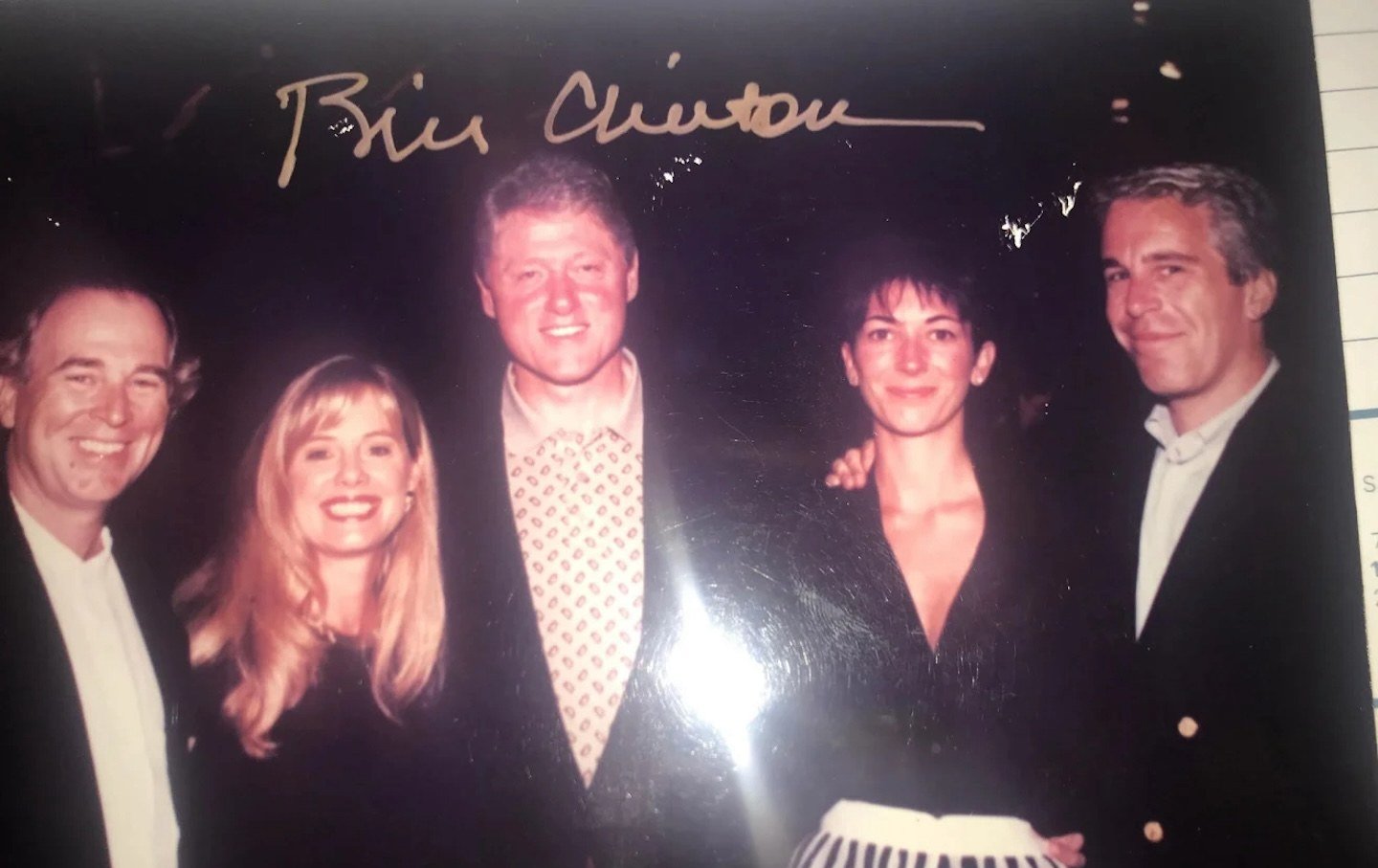
JW: The photos released last week showed Trump at an Epstein event with five young women and Epstein himself in other photos with Larry Summers, Bill Gates, Woody Allen, Richard Branson, the billionaire founder of the Virgin Group, and Epstein’s former lawyer, Harvard Law professor Alan Dershowitz. Most of the speculation about the coming release this Friday focuses on Trump himself and his likely crimes with what Epstein calls “the girls,” as in his statement that Trump “knew about the girls.” But your focus is not on Trump. It’s on the other important men in the story. And there are a lot of them. Some are Republicans, some are Democrats, but you say they all have one thing in common. What is that?
KP: Well, they were not curious about what these young women were doing there. I mean, you would think you go to a mansion in New York and there are all these young women and girls flitting about, or maybe you’re down on that private island, and wouldn’t it, you think it would occur to you to ask, what are these young women doing here? Where did they come from? Why are they here? What’s their story? But people didn’t do that.
JW: And why do you think that is? What does that suggest to us?
KP: Well, to me, what it suggests is that they didn’t care. They were the scenery. They were the “help,”or, as Dominique Strauss-Kahn, this is amazing, memorably put it, “the equipment.” And even people who thought that he hadn’t done anything, didn’t notice, sort of like, yes, he always had this sort of bevy of young women. I mean, he would go up to Harvard with a bevy of young women. Who does that?
JW: Just a quick review here of the basic facts. Jeffrey Epstein went to jail in 2008. That was after a controversial plea deal for state crimes in Florida. And then he was arrested again and jailed in 2019 on federal charges. In that 2008 case, he pleaded guilty to two state felony charges related to prostitution and was sentenced to 18 months in jail, and that was big news everywhere. Everybody read all about the details. The news that came out at that time, this is 2008, reported that “the girls” were as young as 14, that some were high school students. The Palm Beach police had spoken with at least two dozen of them. They said they were lured to Epstein’s Palm Beach mansion under the pretense of a legitimate job as a masseuse, but then pressured or forced to engage in sex acts. And in many cases, the girls had explicitly told Epstein their age. So pretty much everybody knew everything about Epstein and “the girls” in 2008, and yet.
KP: They must not have paid very much attention to it, or they didn’t care. I found some amazing quotes. Here’s Lawrence Krauss, a theoretical physicist, very famous theoretical physicist who I miss – I gave him a Nobel he didn’t deserve in my piece. It hasn’t been corrected yet, but he said, get this: “As a scientist, I always judge things on empirical evidence, and he always has women ages 19 to 23 around.” Imagine how precise that is. How could you possibly know 18, not 17, 18? Okay. “but I’ve never seen anything else. So as a scientist, my presumption is that whatever the problems were, I would believe him over other people.” Why? What’s scientific about that? “I don’t feel tarnished in any way by my relationship with Jeffrey. I feel raised by it.”
JW: “I feel raised by it.” And this was, I understand, in 2011, so this is just three years after Epstein has been found guilty in a trial and sentenced to 18 months in prison. Whatever happened to Lawrence Krauss?
KP: Lawrence Krauss got into trouble for sexual harassment at the University of Arizona State, and he resigned.
JW: I googled him today. It said today he has a Substack and a podcast.
KP: [LAUGHTER] Well, so do many of us.
But here’s another one. Can I read you another incredible quote?
JW: Please.
KP: So he had a friend, an evolutionary biologist, Robert Trivers–also very famous, and he told Reuters in 2015, “girls grow up fast. Now by the time they’re 14 or 15, they’re like grown women were 60 years ago. So I don’t see these acts as so heinous.”
Can you believe it? I mean, that’s incredible. It’s unclear from that quote whether he means they’re like grown women were physically, or they’re like grown women psychologically, but neither of those things are true. So I do see those acts as “so heinous,” and so should he. And there were a lot of these people were, they were not really very astute people in terms of ordinary human behavior. And they also, some of them stood to benefit from their association with Epstein, who was ladling out large sums of money to various institutes and departments and research that people were doing. So they had a motive to not see what say, you and I might’ve seen.
JW: Another great quote, actually. My personally favorite quote about all of this is from Alan Dershowitz, who was exposed for having gone to Epstein’s Palm Beach mansion and getting a massage while he was there. But he defends himself by saying, “I kept my underwear on” during the massage.
KP: Well, these people are just incredible.
JW: I found only one exception to the pattern we’re talking about here. Howard Lutnick. He was Epstein’s next-door neighbor on the Upper East Side for 10 years. When he moved in in 2005, Epstein gave Lutnick and his wife a tour of his home. At that time, Lutnick was CEO of a big Wall Street brokerage house. And Epstein showing them around, showed them his massage room, and Lutnick asked him how often he used it, this was all in the New York Post, Lutnick explained that Epstein answered “every day.” and Lutnick continued, “And then he gets weirdly close to me and he says, ‘and the right kind of massage.’” Lutnick said he and his wife at that point exchanged glances, excused themselves and left. “And I decided that I would never again be in the room with that disgusting person ever again.”
It seems like he’s pretty much the only important person I’ve been able to find who said anything like that. And this was eight years before Epstein was convicted in Florida.
KP: Isn’t he our Secretary of Commerce now?
JW: As a matter of fact, he is. So—
KP: Well, maybe he can do something good with the economy, like he did with Epstein!
JW: And Epstein was of course interested in Harvard and spent a lot of time with Larry Summers and his wife.
KP: In fact, Larry Summers kept up a correspondence with Epstein long after he had ceased to be the president of Harvard. And Larry Summers, can you believe this, he wants to seduce a mentee, a Chinese economist who was teaching at the LSE, the London School of Economics.
JW: And had been a Harvard student while he was president.
KP: Although not his student. But anyway, he’s asking Jeffrey Epstein for advice, for romantic advice about how he can get this woman into bed. And you’re just thinking, well, she’s not 12, so I wouldn’t ask him. It’s just shocking. And it was so pathetic and, also so wrong.
Now, his wife, Elisa New, she’s a special interest to me because she was a professor of English at Harvard and she was doing a, or wanted to do at that time, a poetry program for PBS in which get this, this is like the worst idea in the world. She would have famous celebrities like Bono or Serena Williams read poetry. And so, she was getting help from Jeffrey for two things. One was his help to be able to approach these, have an entree into these celebrities to get them to do this. And the other was money, that she wanted a million dollars for this program. And Jeffrey Epstein had a lot of contacts, and eventually she did get money from a contact of his.
JW: Were they going to read your poems?
KP: No! And that’s another thing I hold against her. How about a poem by me? [LAUGHTER]
What was particularly amazing was that she, there’s one email where she says, ‘oh, Jeffrey, thank you. Thank you. This is so wonderful. I really appreciate this. And you know, I’m going to go upstairs right now and find my copy of Lolita, because I think it’s a book you might really enjoy.’
JW: [Laughter] You’re kidding!
KP: ‘It’s about the lifelong impression made on an older man by a young woman.’ That’s not really what Lolita was about.
JW: ‘Impression.’ Indeed!
KP: Yes. Impressions.
KP: There was another person who we should mention.
JW: Yes?
KP: Chomsky.
JW: Noam Chomsky.
KP: In the email dump, there’s a recommendation for Jeffrey Epstein, apparently from Chomsky, although not signed, that just says, ‘oh, he’s the most brilliant person I’ve ever met. He’s just so wonderful in every conceivable way.’ And Greg Grandin in The Nation suggests that Jeffrey Epstein himself wrote this. It’s not signed, and, says Greg Grandin, it’s not in his characteristic prose style.
JW: And it’s not on MIT letterhead.
KP: It could be a draft. I know I don’t know about that.
But what I do know about Noam Chomsky, and this I think is kind of awful: he says, when he was asked in 2023 about his extensive contacts with Epstein over many years, “what was known about Jeffrey Epstein was that he had been convicted of a crime and had served his sentence. According to US laws and norms, that yields a clean slate.”
Now, this isn’t true. After all, he was a registered sex offender for life in two states. So that’s not a clean slate. But also, I just want to say – ‘a crime.’ I mean, some crimes are worse than others, and soliciting prostitution from a 14-year-old is certainly one of worse than say, passing a bad check. I just didn’t get the feeling that Chomsky was too interested in this. In curiosity of these people, I keep coming back to that, if one of my friends had done time for a crime, I’d want to know more about it, wouldn’t you? And they don’t. Why is that?
JW: Chomsky’s defenders say, when he was called by the Wall Street Journal, he was 94 years old. This was just a couple of months before the stroke that left him disabled and unable to speak. He was asked about a 2015 relationship with Epstein, in view of his 2008 conviction. But I certainly agree with you that what he said was kind of awful.
KP: Well, he is very old, and maybe we should cut him some slack for that. But you just think somewhere along the way there would’ve been the glimmer of curiosity, of distaste, of horror. I mean, okay, incurious before. But what about now? Very few of them have said, ‘I feel so sorry for those girls and those young women. I had no idea what they were going through. But now that I do know, I just want to apologize to all of them. I’m sorry that I didn’t.’ Nobody has said that.
JW: Katha Pollitt – you can read her piece, “Why Did So Many People in Epstein’s Circle Look the Other Way?” @thenation.com. Thank you, Katha.
KP: Thanks for having me.
[BREAK]
Jon Wiener: Now it’s time to talk about the hidden politics of crossword puzzles. For that we turn to Natan Last. He writes essays, poetry, and crossword puzzles for The New Yorker, The New York Times, The Atlantic, The LA Review of Books and The Nation. His new book is Across the Universe: The Past, Present, and Future of the Crossword Puzzle. We reached him today in Providence Road Island where he’s on a book tour. Natan Last, welcome to the program.
Natan Last: Hey Jon, thanks so much for having me.
JW: These days, The New York Times crossword puzzle and its associated Word Games, has over 1 million paying subscribers for the Games app, more than 10 million daily players. The Times Games app alone, I read, makes $24 million a year. So the puzzle is big business.
NL: It absolutely is. There’s an internal joke at The Times that the company has now become a gaming outfit that just happens to offer news.
JW: A few years ago, you submitted a crossword puzzle to The New York Times and the grid included the word Anwar, A-N-W-A-R, and the clue that you provided was the usual one. What was it?
NL: Just something about Anwar Sadat, the former president of Egypt, who was almost always, I think literally always the direction that clues for that five-letter name take.
JW: But that is not what appeared when the puzzle was published. The clue had been changed by the editors of The Times to what?
NL: The new clue read “terrorist killed in a 2011 American drone strike,” which struck us as strange for many reasons. One, the drone strike was sort of personified as an American, but the fact that al-Awlaki was American is left out. Two, this is a drone strike in my morning puzzle, unclear that that passes the Sunday morning breakfast test as it’s called the dictum, to avoid death or disease in the puzzle and instead just do something a little bit more diverting. But three, it just didn’t really jive with the politics of myself and my co-constructors. That was a puzzle made alongside a class that I teach the JASA crossword class. And that class featured retirees and seniors who’d worked at the ACLU or as civil liberties lawyers elsewhere, who thought that this first extra judicial killing of the Obama-era was not something salutary and were extremely unhappy to have their name associated with it in the puzzle.
JW: Yeah, I looked up al-Awlaki at Wikipedia, and they identify him as “the first US citizen to be targeted and assassinated by a US government drone strike.” You think that would’ve made a better clue?
NL: That sounds way better to me. Much more forthright.
JW: Okay. And of course, there’s a question: the clue described him as a “terrorist,” aside from the fact that should terrorists be killed without judicial process, you weren’t that happy with calling him a terrorist.
NL: Yeah, this was an era in which that word came to have a much more expansive meaning both in common parlance and legally, because al-Awlaki was just someone who spread anti-American vitriol online. He had a YouTube channel, if I’m remembering correctly, and certainly the things he was saying about the country and its future, were not at all rosy, but again, we live in a place where at least until recently, freedom of speech was highly prized and it was extremely unfortunate to have this person just tarred as a terrorist in a way that the crossword puzzle tends to do. We come to clues in The New York Times puzzle and elsewhere expecting this encyclopedic one-to-one relationship between clue and answer. But of course, behind every morsel of language is a point of view and a person instantiating it.
JW: Second example that you talk about in your book was a 2022 Monday puzzle, the easiest of the puzzles, easiest of the week. That one included, on the grid, the entry “clean coal.” And what was the clue that was published for that?
NL: The clue that was published was “greener energy source.” That’s an extremely dubious claim. And originally, Lynn Limpel, who constructed that puzzle, had submitted the clue “dubious source of green energy,” which strikes me as much truer, but also strikes me as just as editorial a position as out-and-out claiming that clean coal is somehow green.
JW: I understand that there was a protest to puzzle editor Will Shortz about defining clean coal as “greener energy source” and he actually defended it.
NL: That’s right. The original clue instigated some back and forth, and eventually the editors at The Times decided that “greener energy source” was more concise, it didn’t hedge, and went with that. And there was a solvership uproar. So people who happened to be both dedicated New York Times crossword solvers and activists and policy researchers in the environmental space took to Twitter and decried the clue in really intense tones. Some thinking about this is the same kind of anodyne climate copy that gives denialists cover, right? That this was an extremely intense misstep, and it did broaden this debate about what role the puzzle like the rest of the paper has in pushing everything from misinformation to tweaked and skewed information to all of the above.
JW: And of course, what we want from The New York Times is a correction. And in this case, the most unusual of all corrections appeared a correction to a clue in the crossword puzzle. Tell us about that.
NL: That’s right. The Times issued that rarest of things, a crossword correction — which read “the clue for 47 across in the Monday puzzle implied incorrectly that coal is a viable source of clean energy.” And then it went on to hedge a little bit further: “While it is possible to capture and sequester some of the greenhouse gas emissions and other pollutants from coal-fired power plants, the technology has never been used on a large scale because of its high cost.” And so you get that classic second sentence of any apology, sort of going one step back and saying, well, we had reason for this.
JW: We’ve looked at a couple of political controversies about crossword clues that have to deal with current political debates. You have some other really interesting ones about how clues have changed as our historical knowledge has changed as our understanding of history has changed. A great example is the history of how Mau Mau is clued. Tell us about that.
NL: Yeah, so M-A-U-M-A-U, those are great crossword letters. You’ve got four vowels, which is a really great ratio, crossword constructors need those vowel heavy words. And the Mau Mau are of course the rebels who threw off British colonial rule in Kenya, this is part of the decolonization push in the fifties and sixties. And when in the early fifties that answer appeared in The Times, the clue just as the international reporting desks would’ve had it, read something like “African terrorist” or “Kenyan menace.” And later, as the decades go on, The Times clues as well as the international reporting desks continue to say something like “African terrorists,” you have this racist othering lens on the event, and it isn’t until 2013 that the clues speak any modicum of truth to power and go something like K”enyan rebels who fought for independence from British rule.” Same event, same historical, same historical stage, just the way history books have reinterpreted the events, so too, can the crossword correct the record.
JW: And an even broader change occurs around the word “India.”
NL: That’s right. Yeah, when “India” first appears in the puzzle, it’s not even clued very frequently by reference to the country. The early clues for “India” are things like “Kipling story setting” or even “where George Orwell was born” — because his father worked in the colonial administration there. And so, rather than clues about the rich history of the subcontinent, some cultural item that the country has produced, you instead get these white lenses on the country and its history. And it took a long time for, in particular South Asian crossword makers to push for more interesting lenses on the country. Clues that reference raga or reference the immense food history and contributions, something that’s actually about India, not a high bar.
JW: Then there’s the question of who writes the puzzles. You’ve emphasized that most of the crossword puzzle authors are white men, but in 2020 you say there was a woman who submitted a puzzle where all the names that appeared in the puzzle were of women. No men’s names appeared in the grid. What happened to that puzzle?
NL: That puzzle had one clue changed. I believe it was for D-E-E, which then was changed to “Billy DeeWilliams,” happily in this case, a Black man and someone worth knowing. But the original intent of the constructor, Sally Hoelscher, was to finally have a puzzle in which every reference was to a woman. And this was of course meant to undo the decades of puzzles in which it’s not at all hard to find references exclusively to men, along the same lines of if the Supreme Court were nine women, it wouldn’t at all make up for the decades in which it was nine men. And that puzzle started a large discussion about what exactly the crossword world needs to do to sort of correct the gender imbalance that’s crept up and in fact worsened in the last 10 to 20 years when it comes to who makes the puzzle and therefore often who appears in it.
JW: Last but not least, I want to talk about the clue for the word “illegal” that you objected to, that we all would object to.
NL: I hope so. Yeah. The clue for the word illegal in 2012 read “one caught by border patrol.” And there’s been a huge movement, of course, to not tar any single person as illegal, right? This is a human being who even if they passed into the country in a way that flouts immigration law, which as someone who works in that field, I know you still have to give someone the respect and the dignity to not call them “illegal.” “No person is illegal, no human being is illegal” as the activist chant. And it really was a surprise to the editors of The Times crossword when someone brought up that this was an insensitive and just downright nasty type of clue. And what one wouldn’t expect and what has slowly happened is a softening there that eventually you don’t get the response you got back then, which is, “well, it’s in a dictionary that way,” but rather you now get, “you know what? There’s a ton of ways to clue every single word. We should be thoughtful. Just pause a half second before introducing a clue like that.” So I think, happily, things are mending slowly.
JW: In a completely different key: when we’re talking about politics in the crossword puzzle, we have to talk about the greatest political puzzle of all time: and that was the day of the presidential election in 1996, when Bill Clinton and Bob Dole were basically tied as it went to election day. And the day of the presidential election, The New York Times crossword puzzle had a clue that read ‘the headline of tomorrow’s paper’ – two words, it was going to be ‘blank’ ‘elected,’ and both seven letters. And of course, ‘Clinton’ fit. How did they do it? Did the puzzle writers know who was going to win the election?
NL: Yeah. So on the Tuesday of election day, 1996, ‘Bob Dole’ and ‘Clinton,’ which are both seven letters long, appeared next to the word ‘elected’ in the New York Times crossword. That night news anchors before the race was called deadpanned to a shocked news watching audience that The Times had been early and flagrant in calling the race. But what had happened was Jeremiah Farrell, the ingenious and devilish constructor of that puzzle, had written clues going down that worked regardless of which candidate you picked for that slot. So one of them: that first letter was ‘Black Halloween Animal,’ which could rightfully be ‘bat’ if you were a Bob Dole fan that day, or ‘cat’ if you were a Clintonite.
JW: And the clue for the last letter of the answer, that worked for both “Clinton” and “Bob Dole,” that clue was “much debated political initials” – and the answer was both “NRA” and “ERA” – “N” for the last letter of “Clinton” and “E” for the last letter of Bob Dole.
NL: And so he’d found this beautiful way to trick the solvership: whereas a crossword normally has one single important solution, this was what was called a Schrödinger puzzle — because it had two solutions that day.
JW: Jeremiah Ferrell: we thank him even now for doing that. That’s my favorite political puzzle. Do you have one?
NL: That’s a great question. I loved a puzzle in that same vein by Ben Tausig that ran in The Times. It was also a Schrödinger puzzle. In this case, it was a puzzle interested in the concept of gender fluidity. So ‘gender fluid’ was an answer, and clues like ‘word that may precede sex’ could be ‘same’ if you chose the M for masculine, or ‘safe’ if you chose the F for feminine. So in a kind of homage to that Jeremiah Ferrell puzzle, but also in a way to update it for the present conversation around gender politics, I thought that was a really ingenious puzzle.
JW: I want to ask one last thing about you. You are not only a writer of crossword puzzles. It says here that you have worked as director of the Asylum Seeker Advocacy Project. Please explain how you work on both asylum seekers and crossword puzzles.
NL: I don’t often know how I find the time, but my day job, my career, has been in policy and economics and immigration policy, and it’s been a great pleasure to work for, in particular, humanitarian migration and migrants, so refugees and asylum seekers for the past 10 years. It’s obviously a very difficult time to work on that issue, but they do in some ways inform each other. And so, by day, I think I’m exposed to cultures, languages, people that aren’t often in The New York Times puzzle, let alone its reportage. And so it’s really nice to open up a blank crossword grid and try to infuse my puzzles with some of the things I’ve learned about the rest of the world through my day job.
JW: And could we end with the crossword puzzler’s cheer, which is the epigraph for your book?
NL: Absolutely. Here it is:
“anger, ire, temper, rage,
era, epoch, eon, age,
do-re-mi and fa-sol-la,
Egyptian Sun God: Ra! Ra!! Ra!!!”
JW: Natan Last. His new book is Across the Universe: The Past, Present, and Future of the Crossword Puzzle. And you can read his article, “The Hidden Politics of the Crossword Puzzle” @thenation.com. Natan, thanks for this book – and thanks for talking with us today.
NL: Thank you so much, Jon.
